
Since the 1980s, China has gradually introduced CNC milling technology in the crankshaft processing field. Initially, three processes were mainly used: CNC turning, CNC internal milling, and CNC turn-broaching to process main journals and connecting rod journals. With the iterative upgrading of machine tools and cutting tools, crankshaft high-speed external milling process emerged and quickly became the mainstream processing method in the industry with its significant advantages.
Both crankshaft high-speed external milling and internal milling processes adopt a structural design of double tool discs, double spindles with single automatic steady rest, featuring efficient processing characteristics. This article will analyze and compare from dimensions of machine structure, processing performance, and economics.
1. Internal Milling Machine Structure Characteristics
1.1 Internal Milling Machine Classification
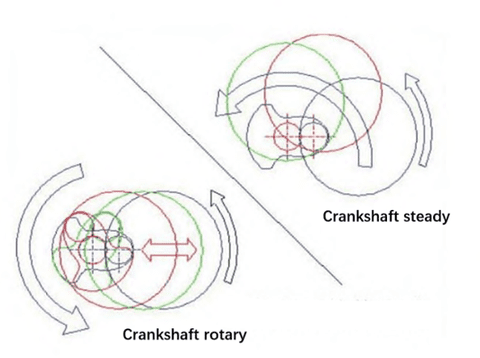
Internal milling machines are divided into two types according to crankshaft motion mode:
- Fixed Type: Achieves cutting through bidirectional interpolation motion of tool disc, requires complex feed mechanism, high spindle rigidity support requirements
- Rotary Type: Only requires unidirectional feed to complete cutting, simplified structure, currently mainstream in the market
1.2 Structural Features
Currently, rotary-type internal milling machines are mainstream, and this article mainly discusses this form for comparison.
1.3 Structural Limitations
- Annular Tool Disc Limitation: Annular tool disc encloses chuck and crankshaft, needs to retract behind chuck during loading/unloading
- Steady Rest Position Limitation: Steady rest must be placed between two tool discs, angular positioning device integrated on chuck
- Space Configuration Limitation: Space between crankshaft bottom and steady rest guide rail cannot be configured for other purposes, tool disc cutting diameter usually 300 mm
2. High-Speed External Milling Machine Structure Advantages
2.1 High-Speed External Milling Machine Structural Features
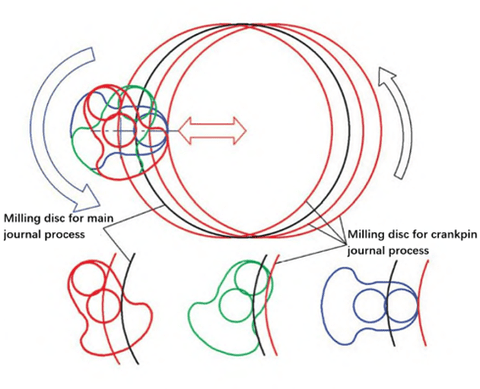
High-speed external milling machine crankshaft is rotating, disc-shaped tool disc is on one side of spindle box and crankshaft, tool disc needs to retract behind chuck jaws during loading/unloading. Cutting processing is performed through crankshaft rotation and tool disc interpolation motion, steady rest can be freely arranged without space limitations, significantly improving support flexibility.
2.2 Space Layout Advantages
Space between crankshaft bottom and steady rest guide rail can be configured with auxiliary devices, tool disc cutting diameter reaches 700–760 mm, far larger than internal milling’s 300 mm.
2.3 Support System Advantages
Multiple steady rests working together further enhance system rigidity, support effect significantly superior to internal milling process.
3. Processing Accuracy and Stability Comparison
3.1 Tool Performance Comparison
Dynamic Performance:
In terms of dynamic performance, high-speed external milling tool disc has large mass (weight 10 times that of internal milling at same thickness), high moment of inertia, effectively suppressing vibration and extending tool life.
Static Performance:
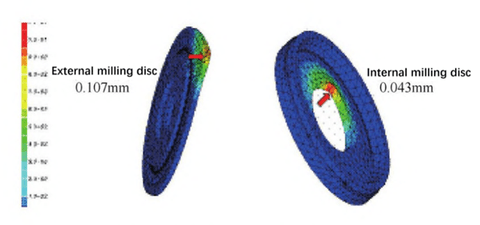
Applying same 5000 N radial pressure to ring tool and disc tool both with thickness of 21 mm at same tool mounting position:
- High-speed external milling disc tool: Produces 0.107 mm displacement
- Internal milling ring tool: Produces 0.043 mm displacement
Internal milling tool disc has better overall static rigidity than high-speed external milling tool disc, but high-speed external milling has superior dynamic performance.
3.2 Spindle System Comparison
Structural Features:
Internal milling machines have large spindle bearing diameter, with large axial and radial rigidity, but high-speed external milling machine spindles can be arranged longer with larger support span. Internal milling machine bearings have large diameter, but limited by structure, support span is smaller compared to high-speed external milling, tool disc support bracket structure is window form with narrow width, not conducive to overcoming moment loads, lateral rigidity smaller than high-speed external milling.
Gap Control:
Ignoring other factors, high-speed external milling’s drive milling head spindle rotating gear gap has greater impact on tools. To change this disadvantage, high-speed external milling machines can add flywheel device at the end of reduction structure shaft, increasing entire system’s moment of inertia, overcoming adverse effects of gaps in entire reduction system. Moreover, during crankshaft milling, tool disc rotation direction remains unchanged, intermediate link gaps will not affect crankshaft processing.
Performance Parameter Comparison:
| Parameter Type | Internal Milling Process | High-Speed External Milling Process | Description |
|---|---|---|---|
| Maximum Cutting Speed | 150 m/min | 350 m/min | High-speed external milling has an increase of 133% compared to internal milling |
| Tool Disc Speed | 160 r/min | 170 r/min | The values are similar |
| Milling Head Spindle Bearing Dn Value | About 80000 | About 32000 | The Dn value of internal milling is 2.5 times that of high-speed external milling |
| Bearing Wear | More prone to wear, short service life | Less wear, long service life | Bearings for internal milling are larger, resulting in higher replacement costs and greater operational difficulty |
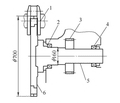
High-speed external milling head structure diagram (1 crankshaft, 2/4 bearings, 3 drive gear, 5 milling head spindle, 6 tool disc)
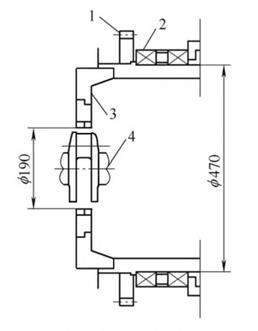
Internal milling head structure diagram (1 drive gear, 2 bearings, 3 tool disc, 4 crankshaft)
3.3 Clamping System Comparison
During crankshaft processing, the weakest link in the entire system of machine, workpiece, and tool is the poor rigidity of the crankshaft itself. Therefore, ensuring crankshaft clamping system rigidity is crucial.
Internal Milling Clamping System:
Internal milling machines are limited by tool disc structure, using two 90° V-shaped jaws for direct clamping support. When machine loads/unloads, annular tool disc and its support structure need to enclose outside chuck. If chuck length is insufficient, spindle box needs to add some overhang, chuck overhang is longer than high-speed external milling machines, unfavorable for clamping rigidity.
High-Speed External Milling Clamping System:
High-speed external milling machines use three-jaw self-centering steady rest for direct clamping support, not limited by tool disc position, can flexibly support at most needed positions, and can configure multiple steady rests as needed, effectively increasing crankshaft’s own rigidity. Auxiliary support effect is significantly superior to internal milling.
3.4 Chip Evacuation and Thermal Management Comparison
Internal Milling Process:
Internal milling tools have short heat dissipation path and time, difficult chip evacuation leads to cutting heat accumulation, transferred to workpiece, tool disc, and spindle, causing workpiece deformation, unfavorable for maintaining workpiece dimensional stability.
High-Speed External Milling Process:
High-speed external milling has longer heat dissipation path and time, insert temperature is relatively low, tools are durable. Chip evacuation is easy with no cutting heat accumulation, minimal impact on workpiece deformation. Low heat transfer is beneficial for maintaining tool disc dimensional stability and workpiece dimensional stability. In terms of chip evacuation and insert cooling, high-speed external milling is significantly superior to internal milling.
3.5 Cutting Mechanics Comparison
Contact Length Analysis:
High-speed external milling cutting contact length is 134.4 mm, internal milling cutting contact length is 151.8 mm. Because maximum contact length is smaller, high-speed external milling causes smaller cutting stress on crankshaft, beneficial for ensuring crankshaft processing accuracy.
Cutting Method:
High-speed external milling inserts use positive rake angle cutting, small cutting stress, maximum cutting speed up to 350 m/min, ensuring higher crankshaft processing accuracy.
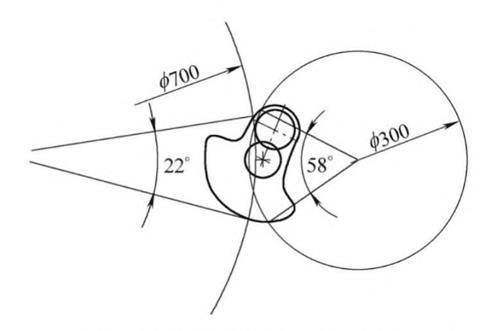
3.6 Accuracy Comparison Data
From the above comparison, high-speed external milling machines have good milling head rigidity, higher clamping rigidity, better cooling and chip evacuation performance, and smaller cutting forces. In the entire system, crankshaft is the weakest link, and high-speed external milling precisely ensures reliable support for it. Comprehensive comparison shows high-speed external milling machines have higher crankshaft processing accuracy and better stability.
Crankshaft Main Journal and Connecting Rod Journal Rough Processing Process Accuracy Comparison:
| Item | Internal Milling (Vc=140–150 m/min) | High-Speed External Milling (Vc=350 m/min) | Advantage |
|---|---|---|---|
| Diameter / mm | ±(0.07–0.10) | ±0.08 | High-speed external milling (more stable accuracy) |
| Roundness / mm | 0.06–0.10 | 0.035–0.05 | High-speed external milling (42% improvement) |
| Axial Dimension / mm | ±(0.07–0.10) | ±0.08 | High-speed external milling (more stable accuracy) |
| Journal Width / mm | ±(0.05–0.10) | ±0.05 | High-speed external milling (higher accuracy) |
| Stroke / mm | ±(0.05–0.10) | ±0.08 | Similar |
| Indexing / mm | ±(0.06–0.15) | ±0.08 | High-speed external milling (more stable accuracy) |
| Surface Roughness Ra / μm | 4.00–8.00 | 0.8–1.6 | High-speed external milling (80% improvement) |
| Flexibility | Good | Best | High-speed external milling |
4. Production Efficiency Comparison
4.1 Cutting Speed Comparison
Internal Milling Process:
Internal milling inserts have low cutting speed (140–150 m/min), few effective teeth, resulting in long cutting time and low efficiency.
High-Speed External Milling Process:
High-speed external milling has high cutting speed (350 m/min), can reduce process cycle time by 30%–50%, low workpiece temperature rise, long tool life, fewer tool changes, high processing accuracy.
4.2 Auxiliary Time Comparison
Internal Milling Process:
Poor insert heat dissipation conditions lead to high tool disc replacement frequency. Moreover, tool disc replacement must be manual operation, requiring more auxiliary time, resulting in long non-cutting time.
High-Speed External Milling Process:
Tool replacement is quick and convenient, high production efficiency.
4.3 Comprehensive Efficiency Analysis
High-speed external milling process leads comprehensively in efficiency, process cycle time reduced by 30%–50%, cycle time shortened by 40%, significantly improving production efficiency.
5. Processing Flexibility Comparison
5.1 Applicable Scenarios
Internal Milling Process:
Internal milling is more suitable for processing larger crankshafts, mainly truck crankshafts and crankshafts with more allowance (allowance exceeding 5 mm).
High-Speed External Milling Process:
High-speed external milling machines are more suitable for processing small passenger car engine crankshafts. With improvement in domestic crankshaft blank manufacturing level, crankshaft processing allowance continues to decrease, high-speed external milling has more advantages.
5.2 Equipment Configuration Flexibility
Internal Milling Machine Limitations:
Internal milling machines are limited by structure, only steady rest can be installed between spindle box and auxiliary spindle box, and steady rest position is also constrained by tool disc position. Other mechanisms cannot be installed, especially fixtures cannot be installed. Fixtures can only be integrated on chuck, making chuck bulky, complex mechanism, expensive, and poor flexibility. Internal milling tool disc cannot pass through steady rest, so one tool disc cannot cut all journals. If one tool disc must process all journals, steady rest and other tool disc must all retract behind chuck jaws, causing very large chuck overhang and poor system rigidity.
High-Speed External Milling Machine Advantages:
High-speed external milling machines can install steady rest, support frame, angular positioning device, and position detection device between spindle box and auxiliary spindle box. Moreover, steady rest position is more flexible with better support effect. This space is not constrained by tool disc movement, can be freely configured. Any tool disc can process all journals, left and right tool discs can perform rough and finish processing separately without affecting other mechanism arrangements.
5.3 Changeover Convenience
When changing crankshaft varieties, high-speed external milling only needs to adjust tool disc, chuck jaws, and support frame V-blocks, etc., to achieve production. High-speed external milling machines have good flexibility and are favored by professional crankshaft processing manufacturers.
6. Economics Comparison
6.1 Initial Investment Comparison
Internal milling machines have higher initial investment, equipment cost significantly higher than high-speed external milling machines.
6.2 Operating Cost Comparison
Internal Milling Process Cost:
- Low processing efficiency means more machine units may be needed
- Short insert service life, higher tool cost
- More auxiliary time needed, therefore higher time cost
High-Speed External Milling Process Cost:
- High processing efficiency, fewer machine units needed
- Long tool life, fewer tool changes, lower tool cost
- Short auxiliary time, low time cost

6.3 Comprehensive Cost Analysis
Compared to high-speed external milling machines, internal milling machines have higher initial investment and operating costs, comprehensively 25% or more higher than high-speed external milling.
7. Summary and Outlook
7.1 Comprehensive Comparison Summary
High-speed external milling process leads comprehensively in accuracy, efficiency, and flexibility compared to internal milling process:
| Comparison Item | Internal Milling Process | High-Speed External Milling Process | Advantage | Improvement |
|---|---|---|---|---|
| Roundness Accuracy | 0.06–0.10 mm | 0.035–0.05 mm | High-speed external milling | 42% improvement |
| Surface Roughness | Ra 4.00–8.00 μm | Ra 0.8–1.6 μm | High-speed external milling | 80% improvement |
| Cutting Speed | 140–150 m/min | 350 m/min | High-speed external milling | 133% improvement |
| Process Cycle Time | Baseline | Reduced by 30%–50% | High-speed external milling | 40% reduction |
| Equipment Utilization | Baseline | Increased by 35% | High-speed external milling | 35% increase |
| Comprehensive Cost | Baseline | Reduced by 25% or more | High-speed external milling | 25%+ reduction |
| Applicable Scenarios | Large crankshafts, allowance > 5 mm | Small passenger car crankshafts | Each has its own advantages | – |
7.2 Application Recommendations
High-Speed External Milling Process Applicable Scenarios:
- Small passenger car engine crankshaft batch production
- Crankshafts with small processing allowance (allowance < 5 mm)
- Production scenarios with high accuracy and efficiency requirements
Internal Milling Process Applicable Scenarios:
- Large crankshaft processing (mainly truck crankshafts)
- Crankshafts with large processing allowance (allowance > 5 mm)
- Heavy-duty crankshaft processing
7.3 Development Trends
High-speed external milling process leads comprehensively in accuracy (roundness improved by 42%), efficiency (cycle time shortened by 40%), and flexibility (equipment utilization increased by 35%), especially suitable for passenger car crankshaft batch production. With improvement in blank accuracy, high-speed external milling will become the core technical route for crankshaft processing.
For comprehensive crankshaft manufacturing solutions, including complete production line planning from raw materials to finished products, equipment selection, and process optimization, we recommend referring to professional Crankshaft Manufacturing Solutions for systematic technical support and services. To learn more about processing equipment or technical consulting, please visit UBright Solutions or Contact Us.