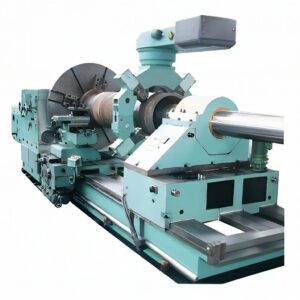
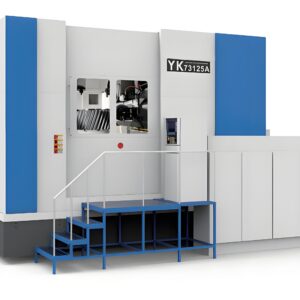
Train Axles Manufacturing Solutions
Train axles are critical safety components that transmit loads between wheels and vehicle body while withstanding extreme fatigue, bending, and torsional stresses. We provide comprehensive manufacturing solutions from forging, heat treatment, precision machining, to non-destructive testing and full traceability, ensuring each axle meets demanding safety requirements for passenger rail, freight rail, high-speed rail, and metro applications.
Common Customer Challenges
- Fatigue Resistance: Achieving superior fatigue life under cyclic loading, vibration, and variable operating conditions for safety and reliability.
- Dimensional Precision: Maintaining tight tolerances on journal diameter, wheel seat geometry, straightness, and concentricity for proper bearing fit and wheel mounting.
- Surface Integrity: Ensuring defect-free surfaces with proper finish, residual stress, and microstructure for fatigue crack prevention.
- Heat Treatment Control: Achieving uniform hardness distribution, core toughness, and surface hardness for wear resistance and structural integrity.
- Non-Destructive Testing: Detecting internal defects, surface cracks, and material discontinuities to ensure structural integrity and safety compliance.
- Traceability Requirements: Maintaining complete material traceability and manufacturing records for safety certification, regulatory compliance, and lifecycle management.
Manufacturing Solutions
Passenger Car Axles
- Technical Points: High fatigue strength, precision bearing journals, balanced design, vibration resistance optimization.
- Process Route: Forging → Heat treatment → Rough machining → Finish machining → Ultrasonic testing → Final inspection.
- Success Case: High-speed passenger axles, speed rating 350 km/h, fatigue life 10 million cycles, dimensional accuracy ±0.02mm on journals.

Freight Car Axles
- Technical Points: Heavy load capacity, impact toughness, wear resistance, robust design for harsh conditions.
- Process Route: Forging → Heat treatment → Machining → Testing → Surface treatment → Inspection.
- Success Case: Heavy-haul freight axles, load capacity 35 tons/axle, fatigue life improvement 40%, service life 30 years.
Locomotive Axles
- Technical Points: High torsional strength, precision gear mounting surfaces, thermal stability, power transmission capability.
- Process Route: Forging → Heat treatment → Precision machining → Testing → Assembly → Validation.
- Success Case: Locomotive drive axles, torque capacity 50 kN·m, torsional fatigue life 8 million cycles, dimensional accuracy ±0.015mm.

Metro And Light Rail Axles
- Technical Points: Compact design, corrosion resistance, noise reduction, frequent start-stop durability.
- Process Route: Forging → Heat treatment → Machining → Surface treatment → Testing → Inspection.
- Success Case: Metro axles, corrosion resistance improvement 50%, fatigue life 8 million cycles, weight optimization 15%.
Train Axles Manufacturing Process
Raw Materials And Incoming Materials Inspection
- Process step description: Verify steel grade (typically EN13261, EA1N, EA4T, AAR M-101), chemistry, mechanical properties, and internal quality through comprehensive testing.
- Equipment: Optical spectrometer, universal testing machine, ultrasonic flaw detector, impact tester, metallographic microscope, hardness tester.
Billet Heating And Preparation
- Process step description: Heat steel billets uniformly to forging temperature (1150-1250°C) with controlled heating rate, soaking time, and temperature uniformity.
- Equipment: Gas or electric heating furnace, temperature recorder, pyrometer, automatic billet handling system, atmosphere control.
Forging And Forming
- Process step description: Press forge heated billets into axle shape with proper grain flow, density, and dimensional accuracy through multi-step forging operations.
- Equipment: Hydraulic press (3000-10000 tons), forging dies, manipulator, thermal imaging camera, dimensional measurement tools.
Heat Treatment And Quenching
- Process step description: Apply quenching and tempering to achieve target microstructure, core toughness, and surface hardness for fatigue resistance and structural integrity.
- Equipment: Heat treatment furnace, quench tank with agitation, tempering furnace, hardness tester, metallographic microscope.
Rough Machining
- Process step description: Machine basic axle geometry including journals, wheel seats, and gear seats to near-final dimensions removing forging scale and irregularities.
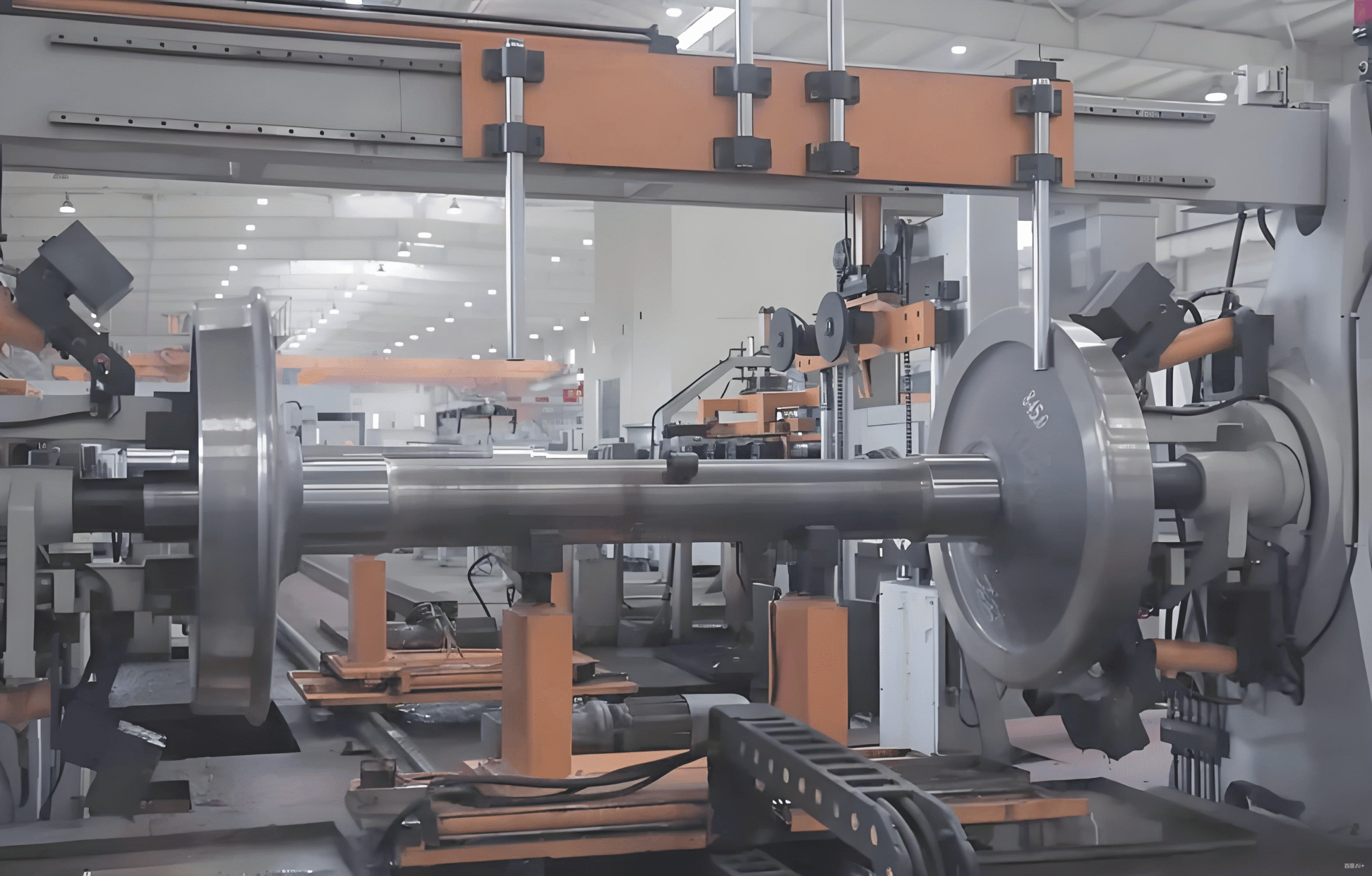
- Equipment: CNC lathe, heavy-duty turning machine, machining center, cutting tools, chip removal system, dimensional gauges.
Stress Relief And Stabilization
- Process step description: Apply stress relief heat treatment to eliminate residual stresses from machining and improve dimensional stability and fatigue resistance.
- Equipment: Stress relief furnace, temperature control system, cooling system, straightness measurement equipment.
Precision Machining And Finishing
- Process step description: Machine final axle profile, bearing journals, wheel seats, gear mounting surfaces to precise dimensions, concentricity, and surface finish.
- Equipment: CNC precision lathe, grinding machine, cylindrical grinder, surface roughness tester, CMM, concentricity gauge.
Ultrasonic Testing And NDT
- Process step description: Perform ultrasonic testing to detect internal defects, inclusions, cracks, and discontinuities throughout the axle body and critical areas.
- Equipment: Ultrasonic flaw detector, immersion tank, automated scanning system, magnetic particle inspection equipment, eddy current tester.
Surface Treatment And Finishing
- Process step description: Apply surface treatments (shot peening, induction hardening, coating) for corrosion protection and fatigue resistance improvement.
- Equipment: Shot peening machine, induction hardening equipment, coating system, surface inspection tools.
Dimensional Inspection And Verification
- Process step description: Measure all critical dimensions including journal diameter, wheel seat diameter, straightness, concentricity, and run-out using precision instruments.
- Equipment: CMM, journal diameter gauge, concentricity gauge, straightness gauge, run-out gauge, digital micrometers.
Marking And Identification
- Process step description: Permanently mark axles with heat number, manufacturing date, axle specification, and traceability codes per railway standards.
- Equipment: Laser marking machine, stamp marking equipment, dot peen marker, barcode system, RFID tagging.
Final Inspection And Certification
Process step description: Conduct final quality checks, generate inspection reports and prepare documentation for airworthiness certification. Equipment: Visual inspection station, documentation system, barcode printer, quality management software.
Data Traceability And Quality Control
- Process step description: Maintain complete traceability of materials, processes and inspections for airworthiness compliance and quality control.
- Equipment: MES, data acquisition system, quality management system, barcode/RFID system, document management.
Train Axles Production Line
Production Line Layout And Configuration
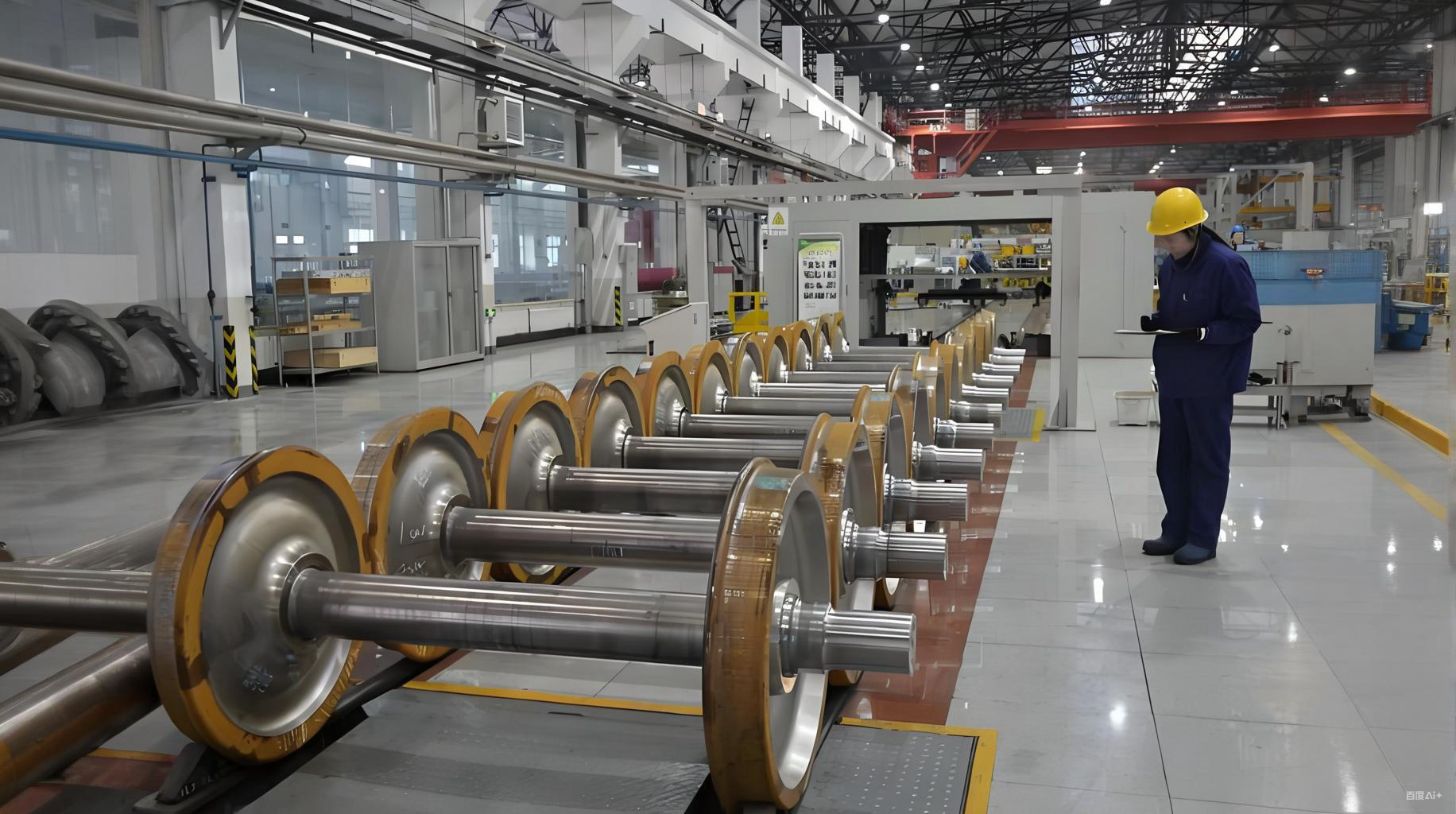
- Overall Layout: Linear layout optimized for long component handling with overhead cranes, roller conveyors, and efficient material flow.
- Workstation Division: Material storage → Heating → Forging → Heat treatment → Rough machining → Finish machining → Testing → Inspection → Storage.
- Logistic Passage: Main aisle 5-6 m wide for crane access, auxiliary aisles 3-4 m; heavy-duty roller conveyors and crane systems for axle handling.
- Buffer Zone Setup: Buffer storage (4-8 hours WIP) between forging, heat treatment, and machining to accommodate batch processing and cooling cycles.
Equipment Configuration And Automation
Forging Station Equipment Configuration
- Hydraulic Presses: 1-2 units, capacity 3000-10000 tons, for axle forging operations.
- Heating Furnaces: 2 units, capacity 8-15 tons/hour, temperature control ±10°C.
- Manipulators: For billet handling and positioning during multi-step forging.
- Automation: Automated temperature monitoring, press control, die changing systems, dimensional measurement.
Heat Treatment Station Equipment Configuration
- Heat Treatment Furnaces: 2-3 units, capacity 2m×2m×4m, temperature control ±5°C.
- Quench Tanks: 2 units, for controlled quenching with agitation and temperature monitoring.
- Tempering Furnaces: 2 units, for stress relief and property optimization.
- Automation:Automatic loading/unloading, temperature curve control, atmosphere monitoring, hardness prediction.
Precision Machining Station Equipment Configuration
- CNC Heavy-Duty Lathes: 3-4 units, for rough and finish turning operations.
- Cylindrical Grinders: 2 units, for precision journal and wheel seat grinding.
- Machining Centers: 1-2 units, for gear seat and special feature machining.
- Automation: Automatic tool changing, in-process measurement, adaptive machining, straightness correction.
Inspection Station Equipment Configuration
- CMM Systems: 1 unit, large-capacity for dimensional verification and geometry analysis.
- Journal Diameter Gauges: Multiple sets for precise bearing journal measurement.
- Straightness Gauges: For axle straightness and run-out verification.
- Automation: Automated measurement sequences, data analysis, statistical reporting, certification generation.
Production Flow And Material Handling
- Material Flow: Raw steel → Heating → Forging → Heat treatment → Rough machining → Finish machining → Testing → Inspection → Storage/Shipping.
- Handling: Overhead cranes (10-30 ton capacity), heavy-duty roller conveyors, automated transfer systems, V-block supports for inter-station movement.
- Protection: Padded V-blocks, controlled handling procedures, rust prevention measures, journal protection caps.