
As a core component of automotive powertrain systems, engine performance directly affects overall vehicle operating quality. The crankshaft, as a key transmission component, has dimensional accuracy and surface machining quality of its journals that not only relate to crankshaft operating smoothness but also directly affect component wear rates and noise control levels. The crankshaft center reamed hole is used to mount the input bearing, which serves the critical function of connecting the engine and transmission, with extremely strict guidance accuracy requirements and a machining tolerance of only 13 μm (H6 grade accuracy). This determines that center hole machining must achieve extremely high precision standards while imposing stringent requirements on machining processes and equipment performance.
1. Center Hole Machining Process Analysis
1.1 Process Overview
Taking a 1.5L four-cylinder engine crankshaft production process flow as an example, OP100 station undertakes three key machining tasks:
- Keyway finish milling
- Signal disk threaded hole machining
- Center hole reaming
This process uses a horizontal machining center equipped with HSK63 tool holder single spindle system, and implements dynamic compensation of machine fixture through Italian Marposs probe during machining to ensure machining accuracy.
1.2 Accuracy Requirements and Technical Parameters
The crankshaft flange center hole is used to mount the gearbox input bearing, with high accuracy requirements and machining tolerance of only 13 μm (H6 grade accuracy). The industry currently commonly uses two finish machining processes:
- Precision grinding on grinding machines
- Precision reaming
This article focuses on the second process—completing hole machining through machining centers with precision reamers.
| Parameter Type | Technical Indicator | Description |
|---|---|---|
| Machining Tolerance | 13 μm | H6 grade accuracy |
| Typical Size | Φ20.976–20.989 mm | Machining size requirement |
| Surface Roughness | Ra < 1.6 μm | Single-edge guide bar tool achievable accuracy |
| Dimensional Accuracy | H8–H7 grade | Single-edge reamer theoretical accuracy |
2. Current Process Status and Problem Diagnosis
2.1 Current Machining Solution
Current flange center hole machining uses a guide bar single-edge reamer with ordinary hydraulic tool holder solution, which can adjust overhang but cannot adjust tool runout. This configuration has the following technical bottlenecks:
2.2 Main Technical Problems
Insufficient Accuracy:
- Single-edge reamer theoretical machining accuracy is H8–H7 grade, unable to meet H6 grade tolerance requirements
System Error Accumulation:
- Hydraulic tool holder runout tolerance: 5 μm
- Tool adjustment tolerance: 5 μm
- Machine spindle runout: 5 μm
- Three cumulative errors exceed the machining size requirement tolerance range of 13 μm
Stability Defects:
- Post-tool-change repeat positioning accuracy fluctuations and spindle wear cause flange center hole diameter out-of-tolerance, with increased dispersion
2.3 Problem Impact Analysis
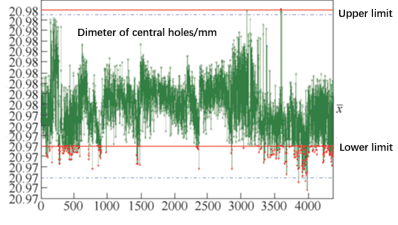
Actual measurement data shows that when machining size requirement is Φ20.976–20.989 mm, approximately 5% of products exhibit out-of-tolerance phenomena, seriously affecting production qualification rates.
3. Process Optimization Solutions
3.1 Reaming Process Overview
In mechanical manufacturing processes, reaming is a widely used machining method, especially in batch production, serving as a finish or semi-finish machining method used as an intermediate machining process for precision parts.
However, in practical applications, reaming has obvious disadvantages, including:
- Difficult hole shape error control
- Inner surface prone to scratches
- Difficult to guarantee machining accuracy for precision part holes, especially slender holes
3.2 Tool Type Comparison Analysis
Current flange center hole guide holes are mainly machined by two types of tools:
- Multi-edge reamers
- Single-edge guide bar tools
![Multi-edge reamer structure diagram] [Image 4: Single-edge guide bar tool structure diagram](https://ubrightsolutions.com/wp-content/uploads/2025/11/image-93.png "Crankshaft Flange Center Hole Precision Machining Guide 2")
3.2.1 Multi-edge Reamer vs Single-edge Guide Bar Tool Comparison
| Comparison Item | Multi-edge Reamer Process | Single-edge Guide Bar Tool Process |
|---|---|---|
| Advantages | • High cutting speed • Simple and reliable design • Easy operation • Can be reground (uncoated cases) • Installation errors generally do not cause complete tool damage | • Good hole quality • Adjustable diameter • Can machine complex stepped holes • Only insert is consumable • Can be used for semi-finish and finish machining • Long tool life |
| Disadvantages | • Slightly inferior hole quality • Limited stepped hole machining • Usually only PCD reamers • Cannot machine series holes and high coaxiality requirement holes • Short tool life | • Lower cutting speed compared to multi-edge reamers • Complex operation • Incorrect tool adjustment easily causes complete tool damage |
3.3 Single-edge Guide Bar Tool Working Principle
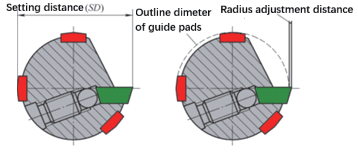
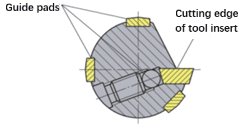
Taking single-edge guide bar tool application in flange center hole machining as an example, single-edge guide bar tools separate cutting and guiding, undertaken by two different parts on the reamer. The tool’s 1 cutting edge (tooth) and 3 guide blocks form a “three points form a circle” positioning principle in the radial section.
After the tool enters the workpiece, it can self-guide, thus potentially achieving higher dimensional and geometric accuracy:
- Dimensional Accuracy: Can reach H8–H7 grade
- Surface Roughness: Ra < 1.6 μm
3.4 Core Optimization Solution
In summary, the main influencing factor for crankshaft flange center hole diameter instability is the tool and spindle matching problem. Due to small flange center hole diameter size tolerance and strict requirements, using conventional ordinary hydraulic tool holders with spindles results in cumulative tolerance exceeding size tolerance requirements, so runout after matching different tools with spindles is unstable, easily causing center hole diameter out-of-tolerance after tool changes.
Solution:
For tool and machine spindle matching, specialized tools can be applied to achieve adjustment in the runout direction. The specialized tool’s adjustable tool holder is divided into two parts, fixed by 8 screws for adjusting tool runout. By installing the tool on the spindle for adjustment, radial runout can be controlled within 3 μm, with regular runout inspection and corresponding adjustments to continuously and stably meet machining requirements.

4. Solution Effect Verification
4.1 Improvement Measures
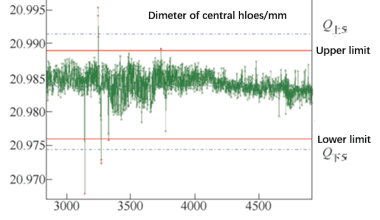
After improving the tool for machining flange center holes, the tool is rigidly fixed and dynamically tested for radial runout on the machine. If out-of-tolerance occurs, adjustment is immediately executed, with significant improvement effects.
4.2 Improvement Effects
| Improvement Item | Before Improvement | After Improvement | Improvement |
|---|---|---|---|
| Out-of-Tolerance Rate | Approximately 5% | Less than 1% | 80% reduction |
| Tool Life | Baseline | Significantly extended | Reduced tool change frequency |
| Spindle Replacement Frequency | Baseline | Reduced | Effectively compensates for spindle runout |
| Machining Stability | Unstable | Significantly improved | Continuously stable |
Specific Improvement Results:
- Flange center hole diameter stability significantly improved: Out-of-tolerance rate reduced from approximately 5% to less than 1%
- Extended tool service life: Reduced tool change frequency and inspection time, lowered operator fatigue, improved overall machine utilization efficiency
- Effectively compensates for increased spindle runout impact: Reduced spindle replacement frequency
- Extended to other application scenarios: Successfully solved flange center hole machining instability problems
5. Summary
As a core component of engines, crankshaft dimensional accuracy requirements are the strictest among all engine components. The flange center hole, as a key connection point between engine and transmission, has extremely high accuracy requirements. In crankshaft machining processes, for dimensions with strict tolerance requirements, if traditional tools and machine matching cannot meet machining accuracy, specialized tools with high-precision spindles must be used to ensure product dimensions meet tolerance requirements.
By adopting specialized adjustable tool holders to optimize tool and spindle matching, radial runout is controlled within 3 μm, out-of-tolerance rate reduced from 5% to less than 1%, significantly improving machining stability and product quality. This optimization solution not only solves current machining accuracy problems but also provides important reference for other high-precision hole machining applications.
For comprehensive crankshaft manufacturing solutions, including complete production line planning from raw materials to finished products, equipment selection, and process optimization, we recommend referring to professional Crankshaft Manufacturing Solutions for systematic technical support and services. To learn more about machining center equipment or technical consulting, please visit UBright Solutions or Contact Us.