
Introduction: The Future of Brake Disc Manufacturing
In recent years, international companies such as TRUMPF and EMAG have successively launched new processes for brake disc laser cladding coatings, and domestic laser equipment integrators have quickly followed suit, developing proprietary solutions with independent intellectual property rights. This technology can significantly improve the high-temperature wear resistance and corrosion resistance of brake discs while effectively reducing fine particle emissions, representing a revolutionary innovation in both technical and environmental fields.
Brake Disc Fundamentals
Definition and Function of Brake Disc
A brake disc (also known as a brake rotor) is a friction component in disc brake systems that rotates with the wheel during vehicle movement. When braking, pistons in the caliper push friction pads to clamp the brake disc, achieving friction braking to slow down or stop the vehicle.
Performance Requirements of Brake Disc
A qualified brake disc must possess not only the required strength and stiffness but also the following key performance characteristics:
- High and stable friction coefficient
- Excellent wear resistance
- Good heat resistance
- Efficient heat dissipation
- Sufficient heat capacity
Brake Disc Classification
Brake discs can be classified by structure or material: solid disc, ventilated disc, drilled disc, slotted disc, drilled and slotted disc, lightweight disc, wave disc, and high-end carbon fiber disc.
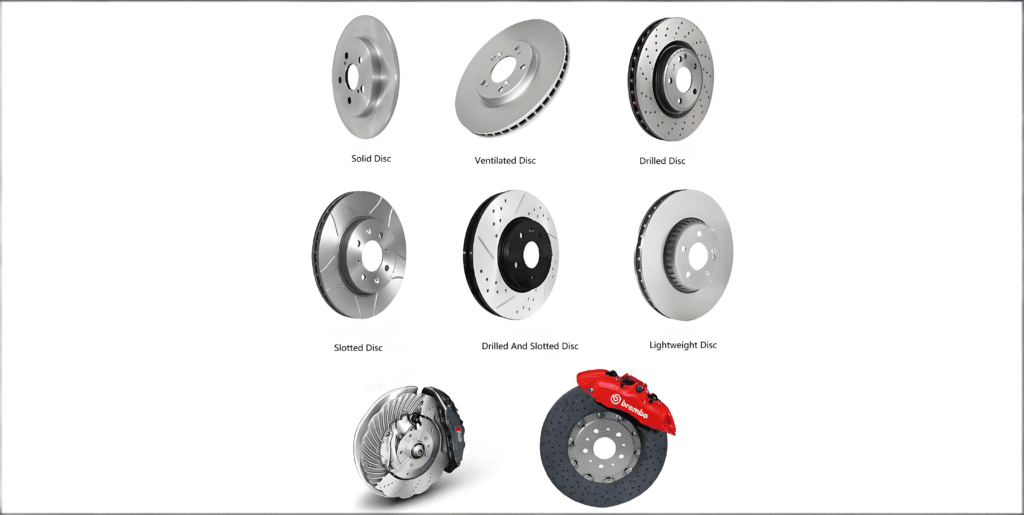
**Note:** While discussing disc brakes, it’s worth mentioning drum brakes. In the passenger vehicle sector, drum brakes have gradually been replaced by disc brakes, but they still play an important role in commercial vehicles and specific industrial scenarios due to their economy and reliability.
Necessity and Value of Laser Cladding
Three Core Performance Improvements
Brake disc laser cladding technology can significantly improve three important performance characteristics:
- High-temperature wear resistance: Significantly extends brake disc service life
- Corrosion resistance: Improves brake disc durability in harsh environments
- Fine particle emission control: Effectively reduces brake system particulate emissions
Limitations of Traditional Brake Discs
Brake discs are consumable components in brake systems. Severe wear can cause significant differences between actual and expected braking distances, affecting driving control and safety. During continuous braking, the surface temperature of the brake disc is much higher than the interior, causing accumulation of friction heat on the friction surface, which can soften the brake disc and affect braking performance.
Challenges of Euro 7 Standards
In recent years, as awareness of the environmental impact of fine dust continues to increase, government agencies worldwide have begun formulating regulations to limit fine particle emissions. The new Euro 7 Standard will take effect for all newly developed light vehicles from November 2026 and for all newly registered light vehicles from November 2027, imposing strict limits on brake system particulate emissions:
| Vehicle Type | Particulate Emission Limit |
|---|---|
| Conventional Light Passenger Vehicles | 7 mg/km |
| Electric Light Passenger Vehicles | 3 mg/km |
| Conventional Light Commercial Vehicles | 11 mg/km |
| Electric Light Commercial Vehicles | 5 mg/km |
Value of Laser Cladding Technology
Apart from tires, these fine particles mainly originate from brake discs and brake friction pads. Even large-scale adoption of electric vehicles cannot change this. The new laser wear-resistant material cladding layer can now achieve wear-resistant and anti-corrosion coatings for automotive brake discs, effectively reducing wear, fine particle pollution, and continuously extending brake system service life.
Laser Cladding Technology Principles
Technical Overview
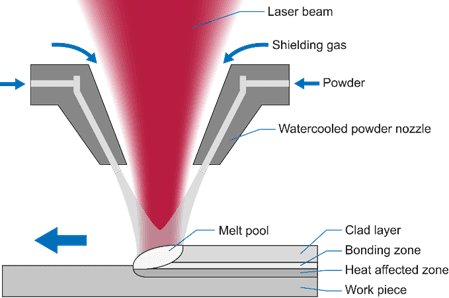
Laser cladding, as a new surface modification technology, can prepare a coating on the brake disc surface that forms a metallurgical bond with the substrate. This technology can improve various coating properties by adjusting powder composition and proportions to meet specific usage requirements.
Process Mechanism
Efficient processing can be achieved by moving components at high speed under the laser beam and powder feeding nozzle. The laser and nozzle are directed at the workpiece from above, causing the sprayed cladding material to melt together with the substrate. The two materials form a metallurgical bond in the melt pool, exhibiting high stability after cooling.
Brake disc cladding is basically completed in two steps:
- Step One: Cladding a buffer corrosion-resistant coating
- Step Two: Cladding a wear-resistant coating with carbide materials
Process Efficiency
The latest process can achieve single-layer brake disc cladding in 30 seconds or less, depending on cladding layer thickness, material, and brake disc size. The premise of this process is minimal energy input and slight fusion between the substrate and cladding material. The entire cladding process can now be completed in 3–5 minutes.
Laser Cladding Process Flow
Using EMAG technology as an example, brake discs need to undergo processing at five main workstations to form double-layer coatings on each side:

Laser Cladding Process Process
Workstation 1: Weighing
In the first workstation, uncoated workpieces are weighed first. The weight value can be used as a reference to determine the coating weight later (after completing one process and before the next weighing). Based on the obtained coating weight results, it can be determined whether the material weight coated on the brake disc is correct.
Workstation 2: Laser Cleaning
Next, the blank workpiece is cleaned in the second workstation to remove surface working materials and contaminants. Pulsed laser acts on the workpiece surface, causing contaminants to evaporate quickly.
Workstation 3: Preheating
In the third workstation, EMAG’s induction heating technology ensures the workpiece reaches the ideal processing temperature.
Workstation 4: Laser Cladding
Now the actual laser coating begins. Each process applies one coating layer—first the adhesive layer, then the carbide coating. The entire process benefits from the clever design of the laser cladding head: powder-based materials are fed through a dedicated channel. During cladding, the powder melts and fuses with the brake disc surface after reaching the melting point.
Workstation 5: Flipping/Measurement
Finally, the rotary table also includes a measurement and flipping workstation. After completing two coatings on the first side of the workpiece, the flipping workstation can be used to flip it for processing the second side.
Laser Cladding Process Advantages
Brake disc laser cladding coatings provide excellent wear resistance, longer brake disc life, and a cleaner driving experience. Double-layer coatings use high-speed laser cladding processes, producing dense, crack-free coatings with excellent corrosion and wear resistance, while reducing fine dust emissions by 30%–50%, complying with Euro 7 regulations. Single-layer coatings are suitable for electric vehicles, providing targeted wear and corrosion protection when mechanical braking is used less frequently.
Application Cases and Effect Analysis
High-Speed Train Applications
Taking high-speed train applications as an example, brake discs, as one of the core components of high-speed train mechanical brake systems, provide important guarantees for safe and smooth operation. Brake discs and brake pads rub against each other, converting train kinetic energy into heat dissipated into the surrounding environment, thereby achieving train deceleration or stopping.
Application Challenges:
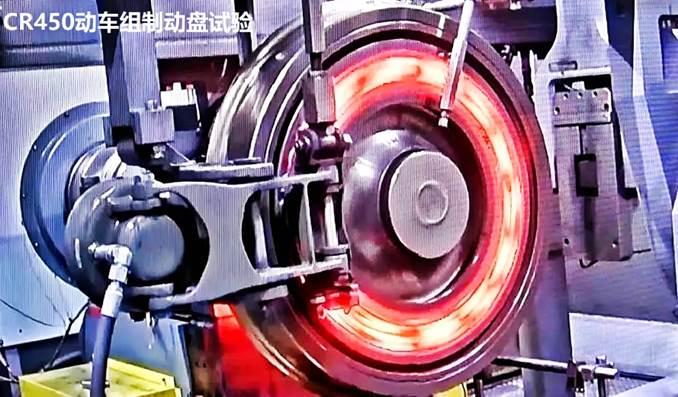
Due to China’s vast high-speed railway network, train operating conditions are complex (such as extreme cold, high temperature, high humidity, high salt, strong wind and sand, and long slopes), combined with high surface temperature rise during high-speed train braking (temperatures can reach 700℃–1000℃) and the need to withstand high-frequency braking cycles (such as station braking), continuous impact under complex conditions leads to excessive wear and thermal cracks in brake discs, seriously affecting train safety.
Actual Application Cases
Case 1: CAS TiC-Enhanced Iron-Based Coating
CAS developed a TiC-enhanced iron-based coating for high-speed rail, improving brake disc high-temperature wear resistance by 40%, already used in some Fuxing train models.
Case 2: CRRC Nickel-Based Alloy Cladding
CRRC adopted nickel-based (Inconel 625) alloy cladding to repair CRH series EMU brake discs, extending service life by 2–3 times.
Case 3: German ICE Train Cobalt-Based Coating
German ICE train brake discs use laser cladding cobalt-based (Stellite 6) coating, improving brake disc life from 600,000 km to 1,200,000 km.
Technical Comparison Analysis
| Comparison Item | Laser Cladding | Traditional Welding/Spraying |
|---|---|---|
| Bond Strength | Metallurgical bond, no delamination risk | Mechanical bond, prone to delamination |
| Heat Input | Localized heating, minimal substrate deformation | Large heat-affected zone, prone to deformation |
| Precision | Controllable coating thickness (0.1–2 mm) | Uneven thickness, requires post-processing |
| Material Utilization | Powder utilization > 90% | High material waste (e.g., arc spraying) |
| Processing Efficiency | Single layer 30 seconds, full process 3–5 minutes | Complex process, time-consuming |
| Environmental Performance | Reduces fine dust emissions by 30%–50% | No significant improvement |
Application Prospects
High-speed rail brake disc laser cladding significantly improves safety and economy through repair and strengthening, especially suitable for high-frequency, high-load operating environments. As China’s rail transit planning increases requirements for key component life, this technology is expected to become one of the standard processes for high-speed rail brake systems.
Summary and Outlook
Technical Advantages Summary
Brake disc laser cladding technology, as a revolutionary surface modification process, can be called a revolutionary innovation in brake discs in both technical and environmental fields. This technology improves the high-temperature wear resistance and corrosion resistance of brake discs while reducing fine particle emissions, providing key technical support for brake system performance improvement and environmental standard compliance.
Development Prospects
With the improvement of process maturity and the acceleration of equipment localization, this technology is expected to achieve large-scale application within the next five years and gradually develop into an industry standard configuration, providing key technical support for the long-term development of industry iteration.
Main Development Directions:
- Process Optimization: Further improve processing efficiency and coating quality
- Cost Reduction: Reduce manufacturing costs through large-scale production
- Application Expansion: Expand from high-speed rail to passenger vehicles, commercial vehicles, and other fields
- Standard Development: Promote the establishment and improvement of industry standards