
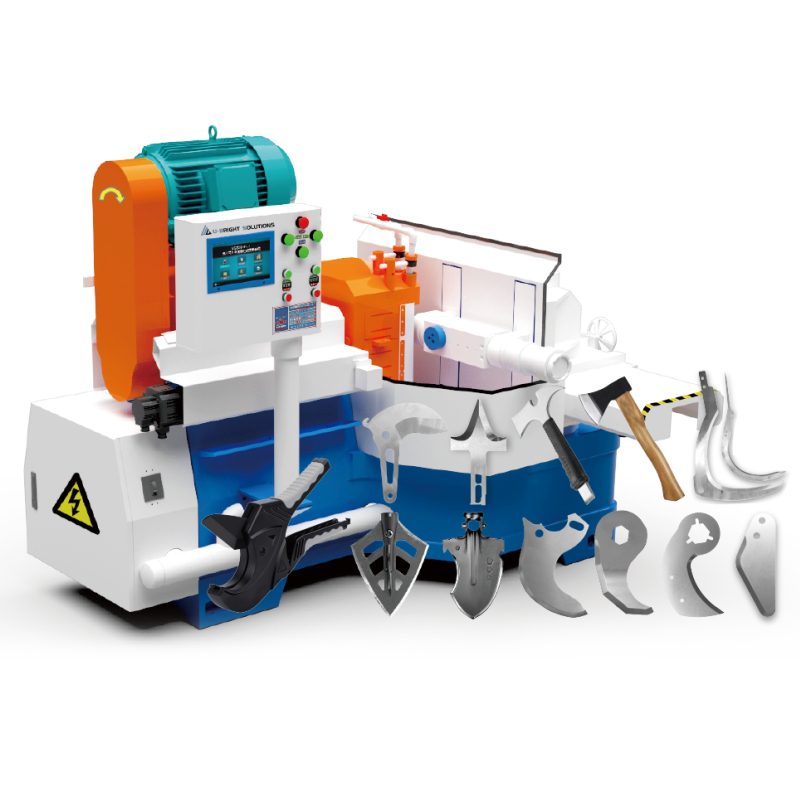
Processing limitations of traditional craft grinders
- Traditional craft grinders once dominated the field of tool edge processing. Their core relied on manual adjustment of the position and angle of the grinding wheel. They once played an important role in tool processing scenarios with small and medium batches and simple blade shapes. However, as the manufacturing industry upgrades to high-end, the requirements for the accuracy and complexity of cutting tools continue to increase, and the shortcomings of traditional processes have become increasingly prominent, which are specifically reflected in the following three aspects:
- Poor accuracy and stability: Processing accuracy completely depends on the operator’s experience and technical level. The edge angle error often exceeds ±2°, and the surface roughness is difficult to stably control at Ra≤1.6μm, which cannot meet the processing needs of high-precision tools.
- Difficulty in machining complex blade shapes: When facing complex blade shapes such as spiral blades and stepped blades, the tool needs to be clamped multiple times for segmented processing. Positioning errors are easily accumulated during the clamping process, resulting in discontinuous blade surfaces and obvious joint marks, which affects the performance of the tool.
- Low production efficiency and consistency: The processing time of a single tool is 2-3 times that of a CNC grinder, and the randomness of manual operations leads to large accuracy differences in the same batch of tools, making it difficult to achieve consistent batch production and unable to adapt to large-scale manufacturing needs.
CNC 5-axis edge grinding: core technology for high-end high-precision machining
The 5-axis CNC grinder (X, Y, Z axes + A, C axes) can achieve high-precision grinding of complex spatial curved surface cutting edges. It is the core solution to meet the tool needs of high-end fields such as medical and aerospace. The core advantages are as follows:
- The 5-axis CNC grinder (X, Y, Z axes + A, C axes) can achieve high-precision grinding of complex spatial curved surface cutting edges. It is the core solution to meet the tool needs of high-end fields such as medical and aerospace. The core advantages are as follows:
- Ultra-high precision and ultimate efficiency: By adjusting the spatial relative position of the tool and the grinding wheel in real time to avoid processing interference, high-precision grinding of complex spatial curved surface edges (such as special-shaped tool edges) can be completed in one go.
- The dimensional accuracy can reach ±0.002mm, and the surface roughness Ra≤0.02μm. The accuracy far exceeds that of traditional processes. At the same time, multi-axis linkage greatly reduces processing steps. For example, special-shaped tool processing requires 5-6 processes in traditional processes, but only 1-2 processes can be completed with a 5-axis grinder. The efficiency is 2-3 times higher than that of traditional grinders.
- Minimizing clamping errors: The multi-faceted and multi-edge processing of the tool can be completed in one clamping, completely avoiding the positioning errors caused by multiple clampings in traditional processes. For example, when processing a composite tool with both milling and drilling edges, a traditional grinder requires 3-4 clampings, and the cumulative error can easily exceed 0.02mm; a 5-axis grinder can complete all edge processing with one clamping, and the error is controlled within 0.005mm, which greatly improves the overall accuracy of the tool and is suitable for high-precision scenarios such as medical scalpels and aerospace special tools.


