
Driven by the demand for high-efficiency and high-precision machining, crankshaft manufacturing is shifting from traditional turning-based routes to high-speed external milling solutions. This article reviews the essentials of crankshaft structures, explains the principles and key parameters of high-speed external milling, compares it with conventional processes, and evaluates its economic and quality impact to support manufacturing upgrades in powertrain and heavy-duty equipment industries.
Role and Structure of the Crankshaft
Basic Function
The crankshaft is the core component that converts the piston’s reciprocating motion into rotary motion. It carries the impact loads transmitted by the connecting rod and outputs torque to drive engine accessories and the drivetrain.
Structural Composition
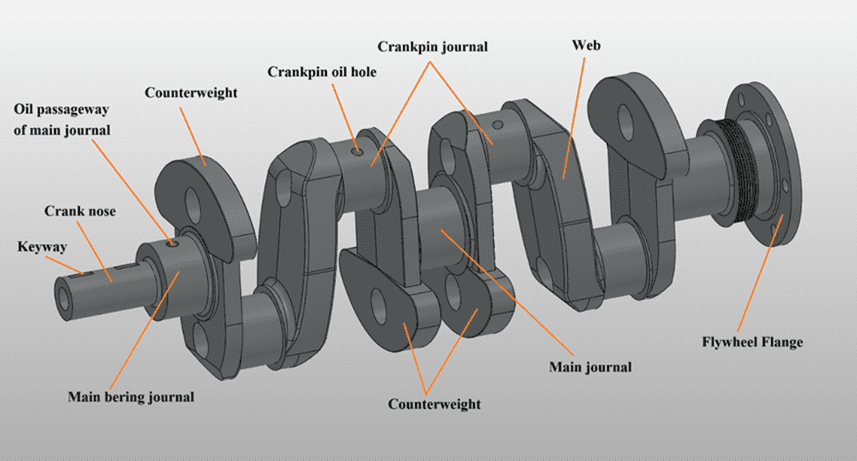
A typical crankshaft consists of:
- Main journal
- Crankpin journal
- Web
- Counterweight
- Oil passageway
- Crank nose
- – Rear side journal
Common materials include alloy forged steel and ductile iron. Some high-performance engines employ micro-alloyed or weldable steels to extend fatigue life.
Principles and Features of High-Speed External Milling
Process Overview
High-speed external milling synchronizes workpiece rotation with cutter feed through servo coordination, enabling simultaneous machining of main and crankpin journal profiles. Unlike traditional external turning, the cutting speed comes from the tool while the feed is generated by workpiece rotation, maintaining a stable cutting angle and load.
Key Parameters
- Cutter diameter: typically 400–630 mm, customizable by crankshaft size
- Cutter materials: PCBN and coated carbide, with ceramic inserts tested for selected conditions
- Cutting speed: up to 350 m/min
- Feed control: eccentric tracking achieved via two NC interpolation axes
- Process stability: thermal deformation kept within 0.02 mm
- Material removal rate: 30%–40% higher than conventional approaches
Technical Advantages
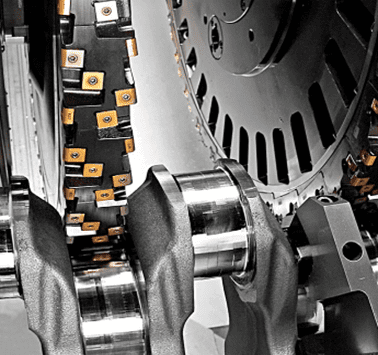
- Machining of multiple journals and grooves in a single setup
- Follow-up milling on crankpins effectively suppresses vibration
- Tool life 20%–30% longer than traditional solutions, reducing tool change frequency
- Supports dual-head or multi-channel configurations to maximize takt utilization
- Provides interfaces for inline measurement and compensation, facilitating digital integration
Comparison with Turning and Turn-Broaching
| Dimension | High-Speed External Milling | Turning / Turn-Broaching |
|---|---|---|
| Cutting power source | Tool rotation delivers cutting speed; workpiece rotation delivers feed | Workpiece rotation delivers cutting speed; tool provides feed |
| Applicable operations | Combined machining of main journals, crankpins, and undercuts | Step-wise machining of concentric journals and grooves |
| Takt time | Single-piece takt reduced by 15%–25% | Takt depends on cumulative multi-step processes |
| Machining accuracy | Profile accuracy reaches pre-grinding level, Ra 1.6 μm | Rough machining level, requires subsequent grinding |
| Tool life | PCBN/coated inserts last longer, fewer tool changes | Relies on carbide tools with shorter life |
| Flexibility | Program changes enable multi-variant production | Process changes require more mechanical adjustments |
| Automation readiness | Easy integration of inline metrology, compensation, digital twins | Limited automation capabilities |
Economic and Quality Benefits
Cost Structure
- Based on mass-production lines, adopting high-speed external milling delivers:
- Approximately 20% shorter cycle time per part, improving equipment OEE
- 15%–20% reduction in tooling cost ratio
- Significant cuts in tool inventory and tool-change downtime
- Better control of thermal deformation and residual stress, lowering subsequent grinding allowance
Quality Control
- Inline monitoring: optional tool-wear tracking and automatic journal-diameter inspection
- Data closed loop: SPC-based analysis enables adaptive tuning of process parameters
- Metallurgical quality: lower defect rates and reduced fluctuation in journal roundness
Summary and Outlook
High-speed external milling combines servo coordination with tooling innovation to simultaneously enhance crankshaft machining efficiency and precision, providing a clear path for upgrading powertrain manufacturing.
Looking ahead, deeper integration of adaptive compensation, inline metrology, ceramic tooling, and digital twin validation will expand the adoption of crankshaft high-speed external milling across construction machinery, commercial vehicles, marine power, compressors, and other sectors, propelling advanced manufacturing toward greater flexibility and intelligence.
To explore more mechanical equipment solutions and selection guides, visit our Machinery Solutions hub.