
As a core component of automotive engines, the crankshaft plays a key role in converting the reciprocating motion of pistons into rotational motion. To reduce friction loss between connecting rods and journals and extend component life, oil passageways are designed on main journals to import and export engine oil for effective lubrication. However, deep hole drilling processes face significant challenges and require systematic process optimization solutions. For comprehensive Crankshaft Manufacturing Solutions, complete process planning from raw materials to finished products is required.
1. Crankshaft Oil Passageway Drilling Process Analysis
1.1 Process Overview
Taking the illustrated crankshaft as an example, its inclined oil passageway has an inner diameter of 8.7 mm, depth of 153 mm, and a length-to-diameter ratio as high as 17.59:1, belonging to the typical deep hole drilling category with significant process difficulty.
During processing, the crankshaft uses the left end face as the positioning datum, with the machine tailstock center fixing both end center holes, and the left floating chuck clamping the first main journal to drive workpiece rotation.
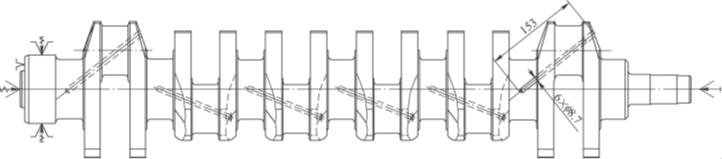
1.2 Deep Hole Drilling Technical Parameters
| Parameter Type | Technical Indicator | Description |
|---|---|---|
| Hole Diameter | 8.7 mm | Inclined oil passageway inner diameter |
| Hole Depth | 153 mm | Depth |
| Length-to-Diameter Ratio | 17.59:1 | Typical deep hole drilling |
| Tool Length | 210 mm | Prone to vibration |
| Spindle Speed | Up to 8000 rpm | CNC machine configuration |
1.3 Current Processing Equipment and Process
Currently, this process uses dedicated CNC machines equipped with high-speed internal cooling drills and independent mist lubrication cooling systems. The machine is configured with a six-station power turret, with maximum spindle speed up to 8000 rpm, capable of simultaneously completing drilling and chamfering operations. The machine’s X, Y, Z, B, A axes are driven by servo motors for precise positioning; the power turret is controlled by AC servo motors with high flexibility.
2. Processing Pain Point Analysis
2.1 Insufficient Tool Rigidity
The processing hole diameter is only 8.7 mm, while the tool length requires 210 mm, with a length-to-diameter ratio as high as 24.1:1, prone to vibration and even breakage. Insufficient tool rigidity is the main technical difficulty in deep hole drilling.
2.2 Heat Dissipation Difficulties
The hole depth causes low drill heat dissipation efficiency, making it difficult for cutting heat to dissipate in time, easily leading to tool overheating, shortened tool life, and even tool burn.
2.3 Poor Chip Evacuation
Deep hole chip evacuation is difficult, chips are prone to clogging, affecting processing stability, and in severe cases, can cause tool jamming and breakage.
2.4 Pain Point Summary
| Pain Point | Impact | Severity |
|---|---|---|
| Insufficient Tool Rigidity | Prone to vibration and breakage | High |
| Heat Dissipation Difficulties | Shortened tool life | High |
| Poor Chip Evacuation | Affects processing stability | Medium-High |
3. Process Optimization Solutions
3.1 Positioning Accuracy Improvement
- Fixture Calibration: Use dial indicator to calibrate fixture left end face, ensuring axial runout ≤ 0.02 mm
- Center Optimization: Correct center radial runout ≤ 0.02 mm
3.2 Auxiliary Support Optimization
Install steady rests at the 4th and 5th main journals, adjust lift amount to 0.03–0.05 mm to suppress vibration and deformation, improving processing stability.
3.3 Center Hole Quality Control
Ensure center hole dimensional consistency and roundness compliance to avoid drilling abnormalities. Center hole quality directly affects processing accuracy and stability.
3.4 Cooling System Enhancement
Increase compressed air pressure, optimize tool cooling, lubrication, and chip evacuation efficiency to improve tool life. Specific improvement solutions are detailed in Chapter 4.
4. Cooling System Upgrade Details
4.1 Mist Lubrication System Principle
High-speed internal cooling cutting drills are used, with specialized mist lubrication system for drill lubrication and cooling. The system atomizes lubricating oil through compressed air, forming 0.5 μm mist particles to achieve effective cooling and lubrication of the drill.
4.2 System Workflow
Compressed air enters from the intake port, is pressurized through a booster cylinder, and then divided into two paths:
- First Path: Directly enters the suspended oil particle generator inside the lubricating oil tank, forming 0.5 μm mist particles from the oil in the tank
- Second Path: Enters the tank through a pressure reducing valve
During processing, adjust the pressure difference to spray 0.5 μm mist into the drill interior, achieving triple functions of cooling, lubrication, and chip evacuation.

4.3 Technical Parameters and Configuration
| Parameter Type | Technical Indicator | Description |
|---|---|---|
| Mist Particle Size | 0.5 μm | Suspended oil particle generator |
| Compressed Air Pressure | Adjustable | Pressurized through booster cylinder |
| System Functions | Cooling, Lubrication, Chip Evacuation | Triple functions |
4.4 System Advantages
- Triple Functions: Simultaneously achieve cooling, lubrication, and chip evacuation
- Improve Tool Life: Avoid tool jamming and breakage
- Improve Processing Quality: Enhance processing stability and accuracy
5. Process Improvement Effect Verification
5.1 Stability Improvement
The application of positioning accuracy and auxiliary support improves processing stability, avoiding axial position drift and radial bending of the workpiece, reducing drill breakage rate by 80%.
5.2 Tool Life Extension
After cooling system improvement, cooling and chip evacuation effects during drilling are significantly improved:
- New Tool Service Life: Increased by 1.6 times
- Refurbished Tool Service Life: Increased by 2.8 times
5.3 Efficiency Improvement
After improving tool chip evacuation and lubrication effects, without affecting tool processing life, feed rate optimization enables:
- Single Piece Processing Cycle Time: Reduced from 9.1 minutes to 6.8 minutes (reduced by 25.3%)
- Daily Production: Increased by 35 pieces
5.4 Before and After Optimization Effect Comparison
| Comparison Item | Before Optimization | After Optimization | Improvement |
|---|---|---|---|
| Drill Breakage Rate | Baseline | Reduced by 80% | Significant improvement |
| New Tool Life | Baseline | Increased by 1.6 times | 60% increase |
| Refurbished Tool Life | Baseline | Increased by 2.8 times | 180% increase |
| Single Piece Processing Cycle | 9.1 minutes | 6.8 minutes | Reduced by 25.3% |
| Daily Production | Baseline | Increased by 35 pieces | Significant improvement |
6. Summary and Outlook
6.1 Technical Advantages Summary
Crankshaft oil passageway deep hole drilling process optimization achieves through systematic improvement solutions:
- High Stability: Drill breakage rate reduced by 80%
- Long Life: New tool life increased by 1.6 times, refurbished tool life increased by 2.8 times
- High Efficiency: Single piece processing cycle reduced by 25.3%, daily production increased by 35 pieces
- High Quality: Processing stability and accuracy significantly improved
6.2 Application Prospects
With the popularization of CNC technology, efficient processing equipment is widely used in manufacturing. Crankshaft oil passageway drilling has evolved from ordinary drilling machines, combination machines, gun drills to dedicated CNC machines, with efficiency increased by dozens of times. However, deep hole drilling is still limited by drill rigidity and environmental sensitivity.
Future Development Directions:
- Intelligent Upgrade: AI parameter optimization, adaptive control
- Automation Deepening: Fully automatic loading/unloading, online inspection
- Precision Improvement: Process optimization under higher precision requirements
- System Integration: Deep integration with MES systems
Only by ensuring fixture reliability and lubrication system stability can the advantages of CNC machines be fully utilized to achieve breakthroughs in both quality and efficiency.
7. Summary
Crankshaft oil passageway deep hole drilling process optimization is a systematic engineering project that requires comprehensive improvements from multiple dimensions including positioning accuracy, auxiliary support, and cooling systems. Through the optimization solutions described in this article, significant results can be achieved: drill breakage rate reduced by 80%, tool life increased by 1.6–2.8 times, and processing efficiency improved by 25.3%. These improvements not only enhance processing quality and efficiency but also provide important reference for continuous optimization of crankshaft manufacturing.
For comprehensive crankshaft manufacturing solutions, including complete production line planning from raw materials to finished products, equipment selection, and process optimization, we recommend referring to professional Crankshaft Manufacturing Solutions for systematic technical support and services.