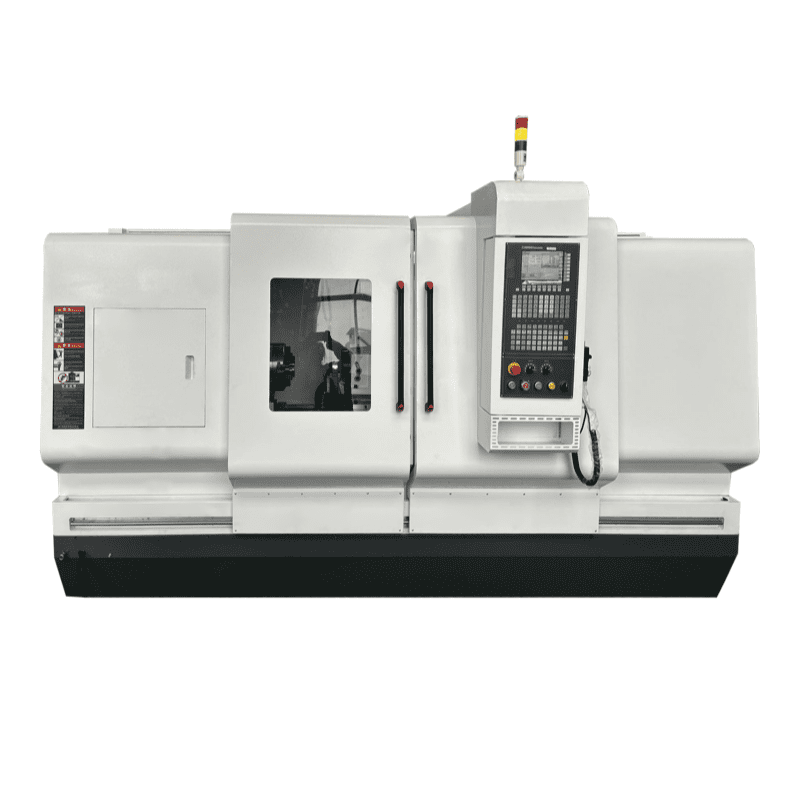
PH50-1000 CNC rotor whirling machine

The PH50-1000 CNC Rotor Whirling Milling Machine is a specialized piece of equipment designed for high-efficiency and high-precision rotor machining. Its core advantages are as follows:
  1. Rigid Structure: Integrated high-strength bed frame combined with 55° dovetail guideways ensures excellent wear resistance and eliminates crawling during low-speed feeding.
  2. Precision Transmission: The feed axes are equipped with precision ball screws and Siemens servo motors, delivering a positioning accuracy of ≤0.015 mm.
  3. High-Efficiency Cutting: A variable-frequency motor drives the whirling head to rapidly remove machining allowances.
  4. Full-Cycle Services: Customized solutions, installation and commissioning, and personnel training are available.
This machine is suitable for machining complex workpieces such as plastering machine rotors, lead screws, and worm gears, helping customers improve production efficiency, stabilize product quality, and reduce manufacturing costs.
Are you still troubled by low efficiency, high costs, and poor precision in rotor machining? The PH50-1000 CNC Rotor Whirling Milling Machine offers you a one-stop solution:

① The single-rotor machining time is drastically reduced from 4–6 hours to just 8 minutes, boosting efficiency by over 30 times;

② The surface finish is stably maintained at Ra 1.6–3.2, far exceeding industry standards;

③ The unit machining cost is cut by 52%, equipment occupancy costs are reduced by 97%, and labor and energy consumption are significantly lowered.

This machine not only breaks through the bottlenecks of traditional machining processes, but also helps you seize market opportunities and respond rapidly to order demands.

Workpiece literacy

The rotor is the core component of a plastering machine’s power system, undertaking the functions of power transmission and operation drive. It drives the mixing blades/conveying screw to rotate at high speed, achieving uniform mixing and stable conveying of mortar.
Made primarily from high-strength alloy steel (e.g., forged 45# steel), the rotor features a complex helical surface structure, imposing extremely stringent requirements on machining precision and surface finish. Inadequate precision will cause unstable power transmission and shorten the service life of the plastering machine; poor surface finish will intensify wear and tear and increase maintenance costs.
Common risks include: delayed orders caused by low efficiency of traditional machining processes, customer complaints arising from substandard surface finish, and squeezed profit margins due to excessively high costs.

Core pain points

There are three core pain points in machining rotors with traditional vertical machining centers:

Low Efficiency: Single-piece machining takes 4–6 hours, failing to meet the delivery requirements of bulk orders;

Unstable Quality: Surface finish is mostly above Ra 3.2 with significant tolerance fluctuations, resulting in a 5% rejection rate;

Excessively High Costs: Prolonged equipment occupancy, manual monitoring, and power consumption keep unit machining costs high. In addition, rapid equipment wear leads to a year-on-year increase in maintenance expenses.

These pain points directly affect the factory’s production capacity, profit margins and market competitiveness.

Overview of the Process Flow

The PH50-1000 adopts the process of blank pre-treatment → rough machining → finish machining:

① High-strength forgings are selected as blanks (to minimize deformation) and undergo annealing stress-relief pre-treatment;

Rough Machining: The whirling head rapidly cuts off the machining allowance;

Finish Machining: Servo-driven systems ensure precise tool path movement.

Key points of each link

  • Blank Pre-treatment: Alloy steel forgings are selected as the blank material. The annealing process is applied to eliminate residual stress and reduce the risk of machining deformation.

    Key Equipment: Annealing furnace

  • Rough Machining: The PH50-1000 is equipped with an integrated high-strength bed frame and 55° dovetail guideways, ensuring exceptional rigidity and wear resistance. Its whirling head is driven by a variable-frequency motor to achieve high-speed cutting, rapidly removing 80% of the machining allowance.

    Key Equipment: Variable-frequency whirling head, integrated bed frame

  • Finish Machining: The feed axes (Z/X) are fitted with precision ball screws and Siemens servo motors, which deliver high transmission accuracy and smooth tool path movement, thus ensuring the geometric accuracy of the helical surface.

    Key Equipment: Siemens servo system, precision ball screws

Revenue data

IndicatorPH50-1000 ValueTraditional Processing ValueImprovement Degree
Single Rotor Processing Time8 minutes4-6 hours30x+
Surface FinishRa1.6±0.2Ra3.2±0.550% Optimization
Positioning Accuracy≤0.015mm≤0.1mm85% Improvement

Case/Application Scenario

Case Study: A construction machinery manufacturer originally processed rotors using vertical machining centers, with a daily output of only 10 units and an order delivery cycle of 15 days. After introducing the PH50-1000, the daily output increased to 300 units, the delivery cycle was shortened to 2 days, and profits grew by 40%.
Applicable Scenarios: Batch production of plastering machine rotors, lead screw machining, worm machining, and roll machining.

Device parameters and configurations

Serial NumberParameter/Configuration ItemValue/Specification
1ModelPH50-1000
2Number of Axes4-axis Triple Linkage (Z/X/A/C)
3Control SystemSiemens 808D/SYNTEC/DF
4Servo Motor/DriveSiemens Servo System
5Power of Whirlwind Milling HeadVariable Frequency Motor Drive
6Maximum Processing Length700mm
7Outer Diameter Range of Workpiece20-90mm
8Positioning Accuracy (Linear Axis)≤0.015mm
9Repeat Positioning Accuracy (Linear Axis)≤0.01mm
10Surface FinishRa1.6-3.2
11Maximum Spindle Speed0-1500rpm
12Rapid Traverse Speed of Feed Axis4-5m/min
13Machine Weight2800kg
14Overall Dimensions2900×2000×2100mm
15Total Power18kW

Product Related

Scroll to Top

Get In Touch With Us!