
A five-axis casting riser grinding machine is an automated finishing system that combines linear axes and rotary motion to remove risers and finish irregular casting surfaces. It is designed for foundries that need more repeatable tool access, path coverage, and surface control than a manual process can consistently provide.
The source-described five-axis casting riser grinding machine combines XYZ linear slide modules, a rotary module, and a dual-station rotary table. It supports manual teaching for flexible jobs and CAD-based simulation for repeatable casting families. Both routes still require fixture, tool, path, and inspection validation on the actual part.
Table of Contents
- Why Casting Riser Grinding Needs More Than Manual Finishing
- Five-Axis Grinding System Architecture for Complex Castings
- Two Ways to Generate a Grinding Path
- Process Controls That Affect Surface Consistency
- What the Source-Reported Results Mean for Casting Finishing
- FAQ
- Conclusion and Consultation Next Steps
Why Casting Riser Grinding Needs More Than Manual Finishing
Manual riser and gate removal is flexible, but results can vary with operator technique, local curvature, tool angle, and access. On higher-volume work, missed areas, over-grinding, and uneven transitions can affect appearance and dimensional consistency. Dust and abrasive debris also make containment and maintenance important process considerations.
A five-axis casting riser grinding machine addresses changing geometry around risers, gates, and transition areas. A fixed tool posture may not maintain suitable contact as the contour changes. Coordinated linear and rotary motion gives the process more options to manage tool position and orientation along a validated path.
Five-Axis Grinding System Architecture for Complex Castings
The supplied technical source describes a base-and-enclosure structure with X, Y, and Z ball-screw-driven slide modules, a rotary module, and a servo-driven dual-station rotary table. The linear axes position the tool in space; rotary motion adjusts its approach to changing casting surfaces. This arrangement supports five-axis grinding for complex casting surfaces where one fixed orientation cannot provide consistent access.
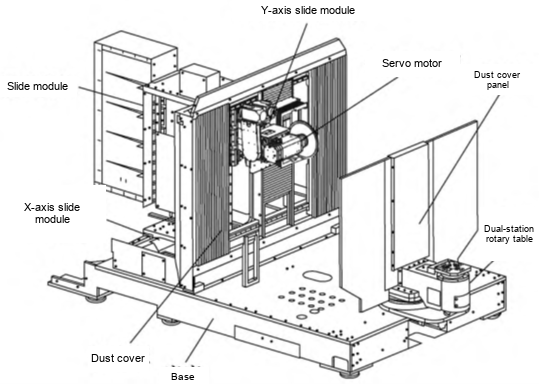
XYZ Linear Motion, Rotary Tool Positioning, and Dual-Station Workholding
A five-axis casting riser grinding machine uses the linear axes to reach the programmed zone and the rotary module to help maintain an application-appropriate tool posture. The dual-station table can support an orderly sequence of loading, locating, and grinding, subject to casting mass, fixture access, clearances, and required finishing zones.
Dust Protection, Chip Collection, and Dedicated Fixtures
The source describes protective covers for motion components, collection below the grinding area, and dedicated locating fixtures. These features support maintainability, debris management, and repeatable setup; they are not a substitute for site-specific safety planning. OSHA’s abrasive-wheel machinery requirements cover safeguarding topics including guards, flanges, and work rests for applicable machinery.
Two Ways to Generate a Grinding Path
A five-axis casting riser grinding machine can use manual teaching or a model-driven path workflow. The best route depends on part variation, available engineering data, and the repeatability required.
Manual Teaching for Flexible or Non-Standard Castings
In manual teaching, an operator guides the X, Y, Z slides and rotary module along a reference riser profile. The controller records teaching points, motion type, and speed parameters to create an initial process file. This can suit flexible work, but it still needs a reliable reference casting, stable fixturing, and a checked program before release.
CAD Import and Simulation Verification for Repeatable Programs
For repeatable casting families, CAD-based grinding path simulation for castings provides a structured preparation route. The source describes deriving a riser-edge profile from a 3D casting model, generating an initial trajectory from part and tool parameters, then checking the casting and equipment models in simulation. Any mismatch should be corrected and checked again before an executable file is issued. Simulation improves preparation discipline; it does not guarantee collision-free operation or final finish without shop-floor verification.
Process Controls That Affect Surface Consistency
A five-axis casting riser grinding machine provides motion capability, but consistent finishing depends on the validated combination of path, tool condition, feed behavior, grinding depth, overlap, contact angle, and workpiece support.
Linear and Arc Motion Selection
Linear motion can suit flatter or gently changing areas. At sharp transitions or rapidly changing curvature, it may create less stable contact or over-cutting risk. Arc motion can be more suitable on continuous curves and boundary transitions because it can provide a smoother posture change. A validated program can combine both motion types according to local geometry.
Feed Rate, Grinding Depth, Overlap, and Contact Angle
Complex curves and corners may require lower travel speed or a lower speed multiplier. Flatter regions may permit higher speed after tool load and finish are checked. The source describes 20%–50% path overlap as a starting guideline, not a universal setting. Validate it against casting geometry, abrasive tool, required surface condition, and observed coverage.
This is where an automated casting finishing machine should be evaluated as a complete process, not as an axis-count comparison. Feed rate, removal depth, tool contact, and fixture repeatability should be linked to acceptance criteria for the intended casting gate removal or riser-finishing operation.
What the Source-Reported Results Mean for Casting Finishing
The following figures describe one source-reported optimized application, not typical or guaranteed UBright performance. In that application, average processing time was reported to decrease from 7.8 to 5.1 minutes per part, approximately a 35% reduction. The same source reports an improvement in surface roughness from Ra 3.2 µm to Ra 1.8 µm.
It also reports batch consistency within ±0.15 mm, compared with ±0.5 mm under the prior approach, and a reduction in single-part adjustment time from about 20 minutes to under 5 minutes. For a five-axis casting riser grinding machine evaluation, these figures are best used to frame questions about geometry, fixture, abrasive, removal allowance, inspection method, and acceptance criteria.
FAQ
What is a five-axis casting riser grinding machine?
A five-axis casting riser grinding machine is an automated system that uses three linear axes and rotary motion to position a grinding tool around complex risers, gates, and transition surfaces. Its purpose is to support repeatable paths and tool access beyond a purely manual grinding process.
Why is five-axis motion useful for complex casting riser grinding?
Complex riser regions can change curvature and approach angle quickly. Five-axis motion can help maintain a more suitable relationship between the tool and casting as the path changes. The result still depends on fixture stability, abrasive selection, path validation, and inspection requirements.
When should manual teaching be used instead of CAD simulation?
Manual teaching can suit flexible or non-standard work when a qualified reference casting is available. CAD import and simulation are more suitable for repeatable families that need a documented, revisable path-development workflow before production.
How do linear and arc motion affect casting gate removal?
Linear motion can be effective on flatter regions, while arc motion can be useful across continuous curves and boundary transitions. A validated process may use both motion types according to local geometry rather than forcing one path style across the whole casting.
Which parameters should be validated for casting riser grinding?
Validate feed speed, grinding depth, overlap, contact angle, tool condition, fixture repeatability, and the match between the programmed path and the actual casting. The source’s 20%–50% overlap range is a starting point for trials, not a substitute for application-specific validation.
Are the reported results guaranteed for every casting?
No. The reported time, roughness, consistency, and adjustment results belong to the source-described application. Different materials, riser geometry, fixtures, abrasives, removal allowances, and inspection methods can lead to different outcomes.
Conclusion and Consultation Next Steps
A five-axis casting riser grinding machine can provide a structured route from manual finishing to more repeatable automated casting finishing. The useful question is whether the complete process can maintain controlled tool contact and verified results for the required casting family.
If you are evaluating a five-axis casting riser grinding machine for casting riser grinding or casting gate removal, contact UBright with drawings, material information, riser locations, target finish, and production requirements.
References
- 1910.215 — Abrasive wheel machinery — Supports the general safeguarding context for applicable abrasive-wheel machinery.