
A CNC spline shaft milling machine is a numerically controlled machine tool that hobs evenly distributed keyways (splines) and gear teeth onto cylindrical shafts. It is used for batch production of spline shafts in automotive, agricultural, aerospace, and marine drivelines. This guide explains how it works, what it produces, and what specifications matter when selecting one.
What Is a CNC Spline Shaft Milling Machine?
A CNC spline shaft milling machine is a hobbing-type gear cutting machine for producing splines on shafts. A rotating hob and a synchronously rotating workpiece generate the spline profile by continuous indexing, while the CNC system controls feed, depth, and angular relationships across multiple axes. Because the spline is generated rather than form-cut, a single hob can produce many tooth counts within its module range.
Spline shafts are torque-transmission components: a shaft carries multiple keyways distributed evenly around its circumference, mating with an internal hub so torque transfers without slip. Splines follow standardized profiles such as straight-sided and involute splines, with the latter dimensioned per ISO 4156 internationally and ANSI B92.1 in North America for interchangeability.
Milling vs. Hobbing Terminology
In spline production, “milling” and “hobbing” are often used interchangeably because the dominant CNC process is generating hobbing using a worm-shaped cutter. Strictly, hobbing is a generating method that progressively forms each tooth as the hob and workpiece rotate in timed ratio. A CNC spline shaft milling machine in modern catalogs almost always means a CNC spline hobbing machine.
Core Capabilities and Workpiece Range
A well-specified CNC spline shaft milling machine handles a wider workpiece mix than its name implies:
- Straight-tooth and helical-tooth spline shafts
- Straight and helical cylindrical gears
- Coupling gears and coupling splines
- Stepped gears and crowned (barrel-shaped) gears
Five-axis, three-axis-linked CNC control coordinates the hob spindle, work spindle, axial feed, radial infeed, and hob swivel angle so that helical splines, crowned profiles, and stepped diameters can be cut without re-fixturing. A continuously variable hob spindle of 60–600 r/min lets operators match cutting speed to material hardness and hob coating.
Most machines run high-speed dry cutting under air cooling, with an optional wet-cutting coolant circuit when tool, material, or surface-finish targets demand it.
Industry Applications
Automotive Transmissions and Drive Shafts
Automotive transmission input/output shafts and drive half-shafts rely on splines to couple gears, synchronizers, and constant-velocity joints. CNC spline shaft milling machines produce these shafts in batch with the consistent pitch and tooth-flank geometry needed for quiet, durable power transfer. Tractor transmissions follow the same pattern, with multiple spline shafts between clutch pack and final drive.
Agricultural and Construction Machinery
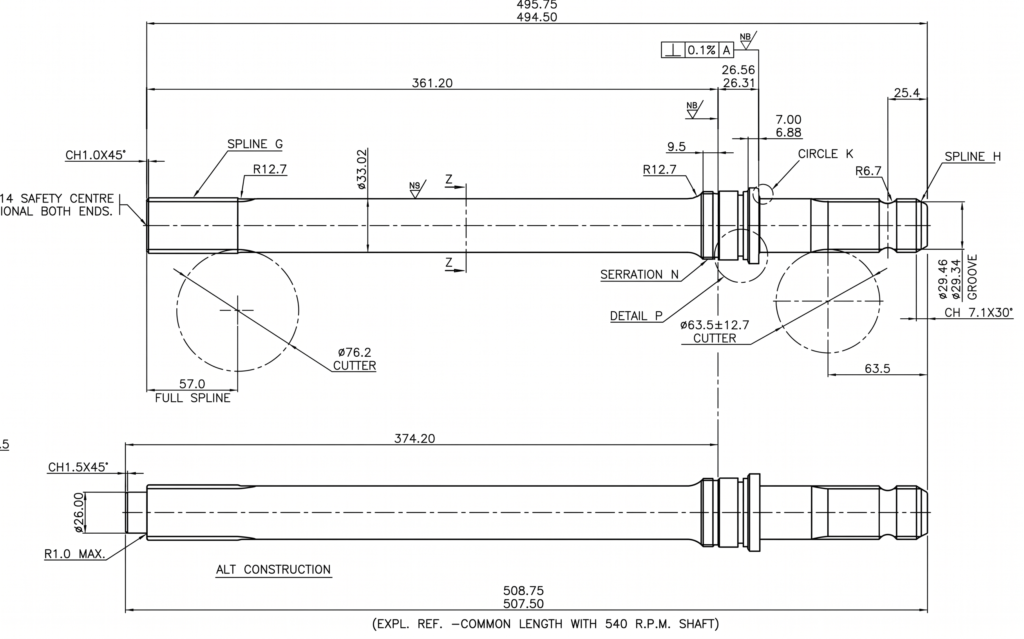
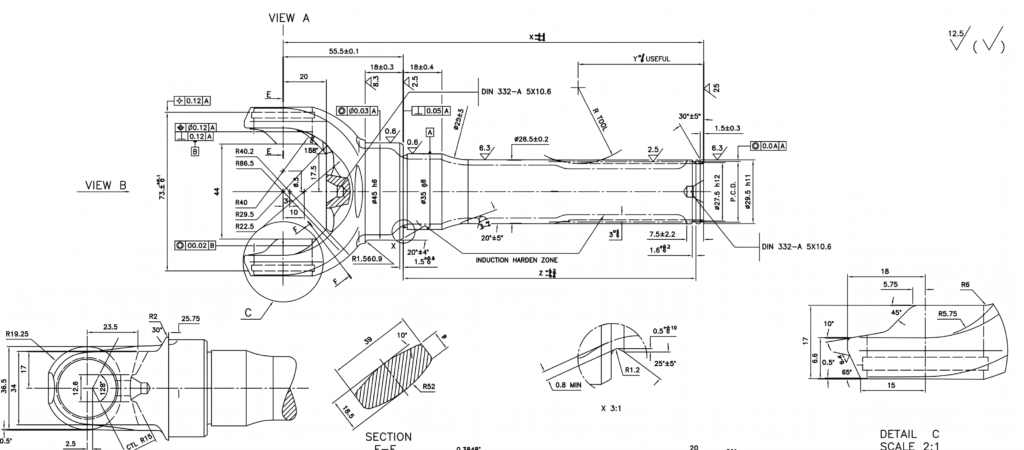
Power take-off shafts, gearbox shafts, and articulated joint shafts on tractors, harvesters, and construction equipment all use splined connections to handle high shock loads. The five-axis, three-axis-linked motion lets a single setup cut multiple spline regions at different diameters and helix angles along the same shaft.
Aerospace Components
Aerospace gearboxes, accessory drives, and rotor shafts demand tight tolerances and traceable geometry. CNC spline shaft milling supports the involute spline profiles common to aerospace standards and produces the surface finish needed before grinding or shot peening.
Marine Propulsion Shafts
Marine reduction gears and propeller drive shafts use heavy-section splined couplings to transfer torque from the engine to the propeller. The 1,000 mm workpiece capacity and Ø125 mm cutting diameter cover the bulk of medium-duty marine spline shafts.
Spline Shaft Manufacturing Process Flow
flowchart LR
    A[Blank shaft<br/>turned to size] --> B[Centering &<br/>between-centers fixturing]
    B --> C[CNC spline milling<br/>hobbing operation]
    C --> D[Deburring]
    D --> E[Inspection<br/>pitch, runout, profile]
    E --> F[Finished spline shaft]
The CNC spline milling step is where the geometry is generated; the upstream and downstream steps exist to support and verify it.
Machine Specifications
The specifications below describe a representative U·Bright Solutions CNC spline shaft milling machine and cover the parameters most often used to judge fit for a given workpiece mix.
| Parameter | Value |
|---|---|
| Maximum machining diameter | Ø125 mm |
| Maximum machining length | 900 mm |
| Maximum module | 3 mm |
| Tooth count range | 6–100 |
| Maximum workpiece length | 1,000 mm |
| Machine center height | 195 mm |
| Tool-to-work centerline distance | 40–150 mm |
| Maximum hob size | Ø130 × 115 mm |
| Arbor diameters | Ø22 / Ø27 / Ø32 mm |
| Hob spindle speed (stepless) | 60–600 r/min |
| Hob swivel angle | ±40° |
| Maximum hob shift | 100 mm |
| Hob shift per revolution | 0.18 mm/r |
| Tailstock center stroke | 40 mm |
Why CNC Spline Shaft Milling Improves Manufacturing Outcomes
CNC control replaces operator-dependent indexing with deterministic motion, which translates into three concrete gains for spline shaft manufacturing:
- Repeatability. Tooth-to-tooth pitch error and lead error stay within tight bounds across an entire batch, reducing reject rates.
- Throughput. Stepless 60–600 r/min hob speeds plus automated hob shift let one machine run multiple part numbers per shift without lengthy resets.
- Process consolidation. Five-axis, three-axis-linked motion cuts straight, helical, stepped, and crowned features in one fixturing, cutting handling time and stack-up tolerances.
These outcomes are why precision spline shaft machining has migrated from manual gear shapers to CNC platforms across automotive, agricultural, and aerospace manufacturing industries.
Frequently Asked Questions
What is the difference between spline shaft milling and hobbing? In modern CNC practice they refer to the same generating process. Hobbing is the specific generating-cut mechanism; spline shaft milling is the broader category name used in machine-tool catalogs.
What spline types can a CNC spline shaft milling machine produce? Straight-tooth splines, helical splines, involute splines, coupling splines, and small-module straight or helical gears. With the hob swivel angle, stepped gears and crowned gears are also possible in a single setup.
What industries use CNC spline shaft milling machines? Automotive transmission and driveline plants, agricultural and construction machinery makers, aerospace gearbox suppliers, and marine drive manufacturers.
How is spline shaft accuracy controlled during CNC milling? Through three levers: hob and arbor concentricity at setup, synchronized hob–work spindle motion under closed-loop CNC control, and stepless hob speed selection that matches cutting load to the workpiece material.
Talk to U·Bright Solutions
U·Bright Solutions supplies CNC spline shaft milling machines and application engineering for batch spline production. To size a machine to your shaft family or match hob settings to a new part number, reach out:
- Email: info@ubrightsolutions.com
- Website: https://www.ubrightsolutions.com/
References
- ISO 4156-1:2005 — Straight cylindrical involute splines — Metric module, side fit — Supports the international standard reference for the involute spline profile used in shaft–hub torque transmission.
- ANSI B92.1 — Involute Splines and Inspection (SAE) — Supports the North American counterpart standard for involute spline geometry and inspection.
- How Gear Hobbing Works — Gear Technology — Supports the description of hobbing as a generating process in which the hob and workpiece rotate in timed ratio.
- Involute Spline ANSI B92.1 Equations and Design — Engineers Edge — Supports the involute spline design data referenced in the spline-types FAQ.