
The camshaft machining process has changed more in the last two decades than in the previous fifty years. A camshaft controls when an engine’s intake and exhaust valves open and close, so its lobe profile, phase angle, and wear resistance directly shape an engine’s power, fuel economy, and emissions. Producing that geometry in hardened alloy steel used to take four separate stages and a shelf full of mechanical templates. Today, two stages do the job: high-speed CNC milling for roughing and CBN grinding for finishing. This guide walks through the modern camshaft machining process step by step and contrasts it with the traditional methods it replaced.
Table of Contents
- What Is the Camshaft Machining Process?
- Face and Center-Hole Machining
- Straightening the Slender Camshaft
- Cam Roughing: From Form Turning to CNC Milling
- Cam Finishing: CBN High-Speed Grinding
- Traditional vs. Modern Camshaft Machining Compared
- Frequently Asked Questions
What Is the Camshaft Machining Process?
The camshaft machining process is the sequence of cutting, grinding, and surface-strengthening operations that turns a forged alloy steel blank into a finished camshaft with accurate lobe profiles and journals. Because the camshaft is a slender shaft with irregular, non-circular lobes, machining allowance is large and uneven, and the alloy content of forged blanks makes consistent quality hard to hold. The work centers on two features: the journals that support the shaft and the cams that drive the valves. Both demand high profile accuracy, correct phase angles, good wear resistance, and overall rigidity.
Traditional alloy steel camshaft machining ran in four stages: rough machining (rough turning of journals and cams), semi-finishing (rough grinding), finishing (finish grinding), and final polishing. The modern process collapses this into two stages: roughing by turning journals and milling cams, then precision finish grinding of journals and cams. Fewer stages, with quality held throughout, is what raises output and lowers cost.
Face and Center-Hole Machining
For most shafts, the axis is the design datum, and the two center holes serve as the locating datum through every later operation. Keeping that datum unified avoids the positioning errors that creep in when a part is re-clamped against different references, so the face and center-hole step sets the ceiling on everything that follows.
The traditional approach used a combined mill-drill machine with adjustable stops to set overall length and center-hole depth. It produced recurring defects: length out of tolerance, center-hole depth errors, the two center holes not concentric, and uneven axial stock on journals and cam flanks that left black (unmachined) skin. To stop the center hole’s own form error from copying into the finished part, shops added a separate center-hole reconditioning step after rough machining and heat treatment.
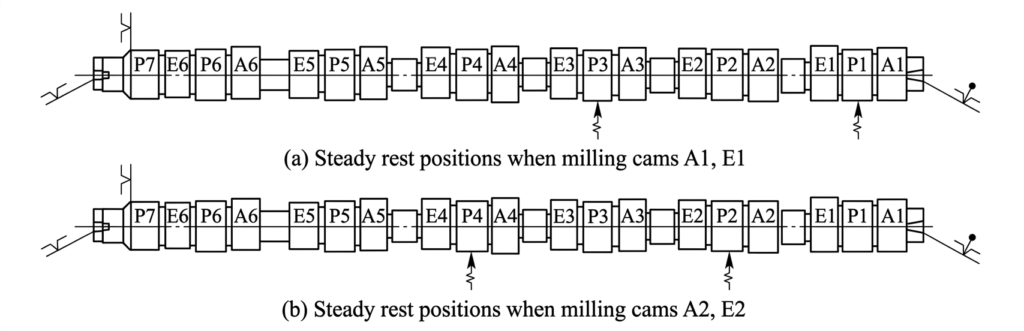
The modern camshaft machining process replaces that with a CNC mill-drill machine. NC code controls center-hole depth and overall length directly, holding both consistently. A skive-turning tool mounted on the center-drill spindle flange machines one journal’s outer diameter in the same setup, while a V-block axially locates the middle journal, so center-hole position and the cutting allowance across journals, cam flanks, and outer surfaces all come out even. Self-centering chucks and a tracking self-centering steady rest limit deflection during cutting, which removes the need for the separate center-hole reconditioning step entirely.

Straightening the Slender Camshaft
A camshaft is a low-rigidity slender shaft, so cutting forces make it vibrate and deflect. That hurts dimensional accuracy, form, and surface finish, reduces the stock left for later operations, and in severe cases bends the part so badly that downstream machining is impossible and the workpiece is scrapped.
Traditional practice fought this with auxiliary supports and sectional machining, plus repeated straightening that was usually done by hand. But straightening a part many times tends to release internal stress incompletely, so the shaft bends again after it leaves the straightening station.
The modern process uses automatic straightening machines that measure and correct the shaft automatically, and it sequences the work to keep distortion low in the first place. During journal and cam machining, the headstock end is gripped in a self-centering chuck with an internal center for auxiliary location while the tailstock end carries an elastic (spring-loaded) center, leaving that end free-overhanging. Roughing is ordered to minimize bending — the steady-rest-supported journal is cut first, then the rest of the journals, then the cam-flank grooves — and a tracking self-centering steady rest carries the middle journal during cam roughing. Critically, straightening is scheduled after rough machining of journals and cams and after heat treatment (quenching and tempering), with enough cooling time for stress to release fully before the shaft is straightened.
Cam Roughing: From Form Turning to CNC Milling
Early cam roughing used mechanical-template form turning. A master template drives a follower through a mechanical linkage so a single tool or multiple tools copy the cam profile onto the rotating workpiece. Single-tool turning held quality reasonably well but was very slow; multi-tool turning was faster but struggled to hold accuracy and still required straightening and rough grinding afterward. Some engine plants substituted heavy-duty grinding for rough turning, but throughput stayed low.
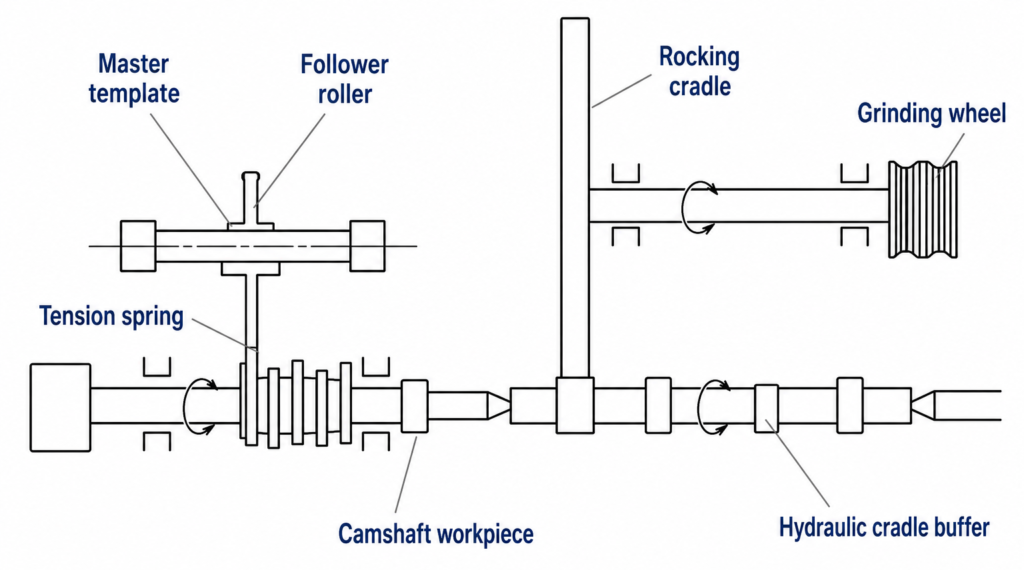
Modern cam roughing uses a CNC milling machine for high-speed milling. The control coordinates the tool slide (X-axis), the workpiece spindle (C-axis), and the table travel (Z-axis) in interpolated profile milling to machine every cam. As the cutter wears, X- and C-axis interpolation compensates so the chip load per tooth stays uniform, while a tracking steady rest prevents excessive bending. Mechanical templates disappear completely: switching to a different camshaft variant is just a new NC program, which gives the process real flexibility. High-efficiency CNC milling and internal-milling machines are now widely used for cam roughing because they combine high throughput with reliable quality and quick model changeovers — making high-speed CNC milling the clear direction for cam roughing.
Cam Finishing: CBN High-Speed Grinding
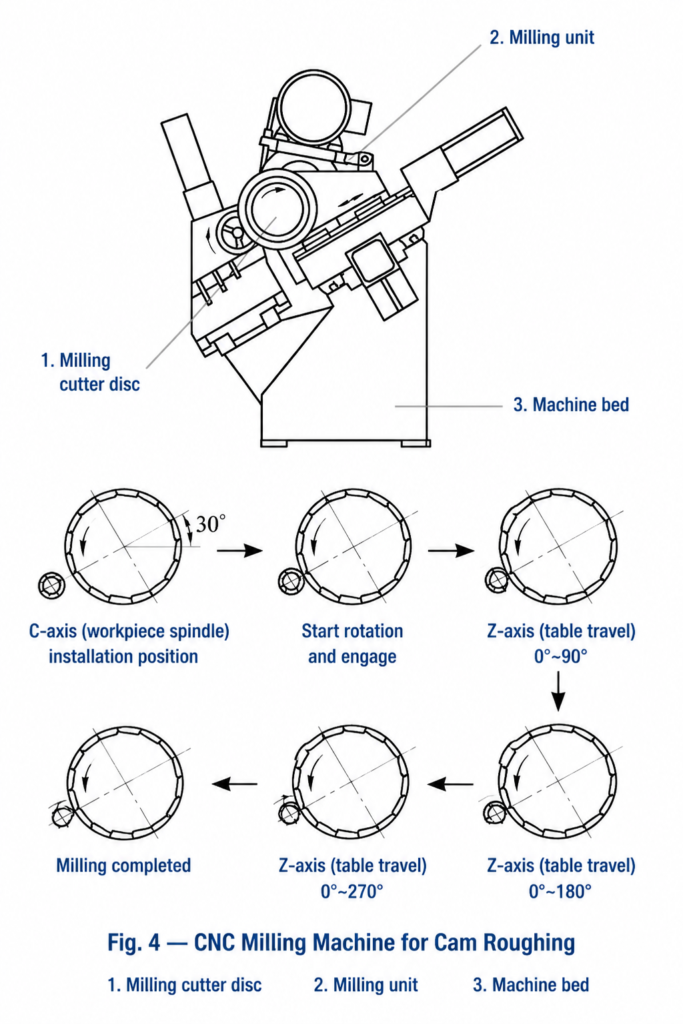
Cam finishing is always done by grinding, and its accuracy depends directly on machine structural precision and the wheel’s grinding characteristics. Traditional finishing used a mechanical-template copying grinder: stacked templates on the headstock shaft rotate with the spindle, spring tension keeps the template against a roller, and as the profile curvature changes it forces a rocking cradle to swing. The workpiece, mounted between centers, rotates at the same speed as the template while the grinding wheel plunges in transversely; a hydraulic buffer steadies the cradle on the cam return flank.
[VISUAL: image | id: image5.jpeg | file: traditional-cam-template-grinding.png | placement: Cam Finishing: CBN High-Speed Grinding | title: Traditional mechanical-template cam grinding principle | alt: Traditional camshaft machining process showing mechanical-template cam grinding with rocking cradle and grinding wheel]
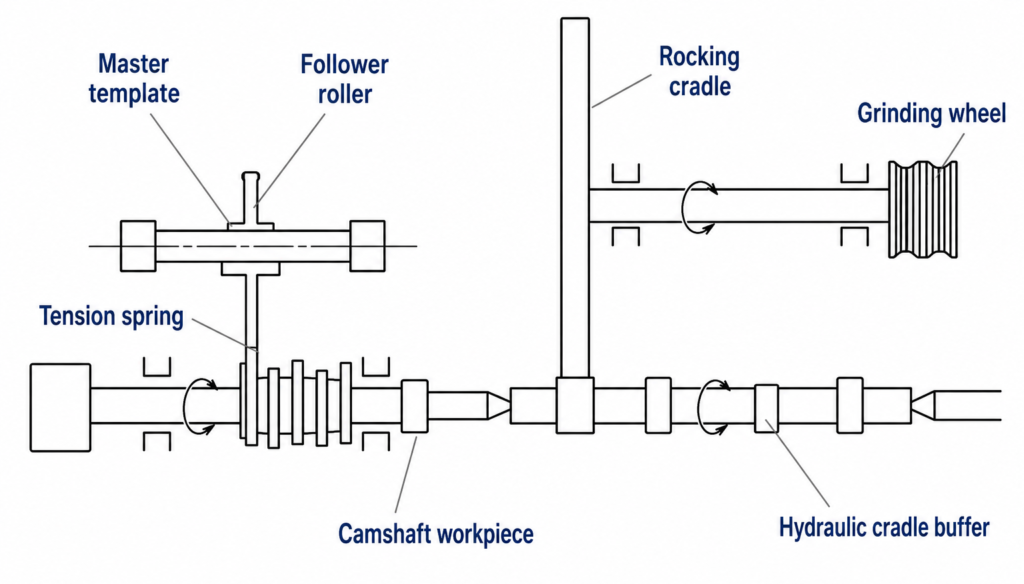
That method carries built-in defects. Grinding at constant workpiece rotation makes the grinding speed vary widely from point to point along the lobe, which causes lift error, waviness, burn, and poor surface quality. As the wheel wears down, the lift profile drifts with wheel diameter, and the template’s own manufacturing precision and progressive wear degrade profile accuracy further. Low wheel speed and outdated single-point dressing keep grinding efficiency low, and each template set fits only one part variant, so every redesign means new rollers and templates and a long setup lead time.
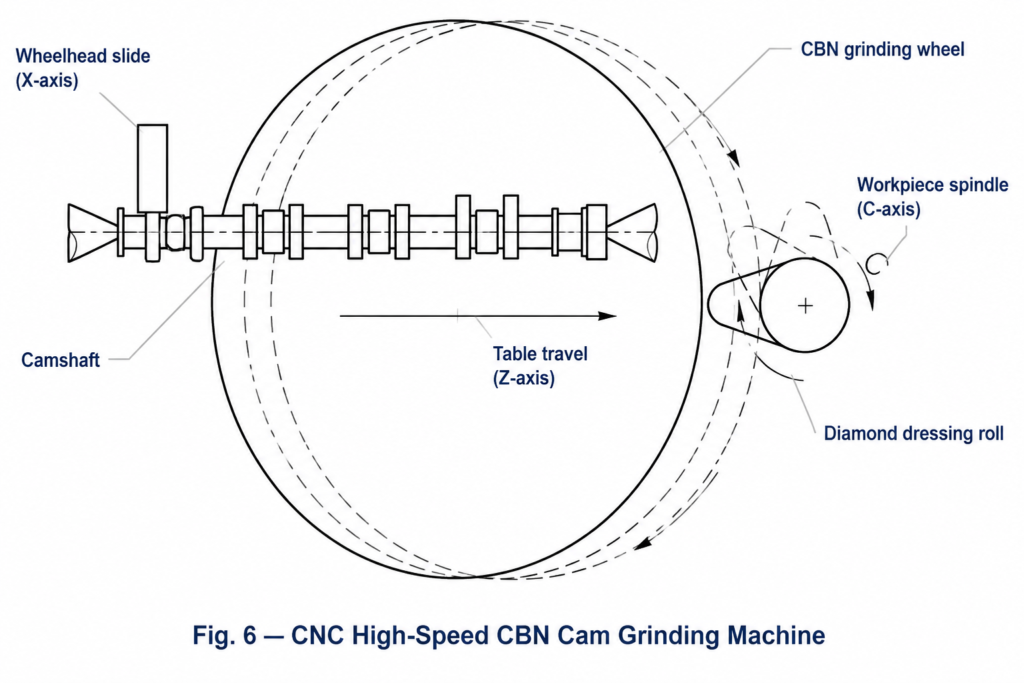
Modern finishing uses a CNC high-speed grinder with a CBN (cubic boron nitride) wheel. The control coordinates the wheelhead slide (X-axis), workpiece spindle (C-axis), and table travel (Z-axis); the operator enters the lift table and dimensions, and the software computes the variable workpiece-speed curve and generates the NC program for every cam. Workpiece speed varies continuously so that the metal removal rate is the same at every point on the lobe — directly solving the constant-speed defect. When wheel diameter changes, the system corrects the program automatically, and measured lift error can be fed back into the lift table as compensation. CBN is a synthetic superabrasive second only to diamond in hardness, with a very stable molecular structure that gives high hardness, thermal stability, chemical inertness, and high compressive strength. Its good thermal conductivity keeps workpiece temperature low, reducing burn and cracking even at high feed rates, and the ground surface carries residual compressive stress that raises fatigue strength and wear life. Continuous diamond-roll dressing and automatic wheel balancing keep the wheel true and quiet at high speed.
Independent investigations of high-speed deep camshaft grinding confirm the thermal advantage, and CBN-with-CNC cam grinding has been documented in automotive engineering literature since the late 1980s.
Traditional vs. Modern Camshaft Machining Compared
The gains are measurable. Using production camshafts from heavy-duty diesel and gasoline engines as reference cases, the modern high-speed CNC process compares to traditional template machining as follows:
| Metric | Traditional process | Modern CNC + CBN process |
|---|---|---|
| Cam profile (lift) error | Baseline | 0.02 mm max — about 1/3 of traditional error |
| Profile stability | Drifts with wheel/template wear | High, with closed-loop lift compensation |
| Surface defects | Burn, chatter, waviness common | Burn and chatter essentially eliminated |
| Cycle time | Baseline | ~1/3 of traditional |
| Unit cost | Baseline | ~1/2 of traditional |
| Floor space / machines | More machines and area | Two fewer machines; less floor space |
| Variant changeover | New templates, long lead time | NC program change; short, low-cost setup |
The summary: the modern camshaft machining process holds tighter, more stable lobe profiles, removes the surface-integrity defects that plagued template grinding, and does it in a third of the time at half the cost while freeing floor space and switching variants in software rather than hardware.
Frequently Asked Questions
How is an alloy steel camshaft hardened during machining?
Surface strengthening is woven into the process rather than bolted on at the end. Common methods are quenching plus tempering, shot peening, and nitriding, chosen for the lobe wear and fatigue demands of the application. The timing matters as much as the method: heat treatment is scheduled before final straightening and finish grinding so that the shaft’s stress is released and corrected before its final geometry is locked in, and CBN finish grinding then leaves a residual compressive stress that further improves fatigue life.
Why use CBN grinding wheels instead of conventional wheels for camshafts?
CBN’s value on camshafts is mostly thermal and economic. Its high thermal conductivity pulls heat out of the grinding zone, so hardened alloy steel can be ground at high feed rates without the burn and cracking that conventional wheels risk on the same material. CBN wheels also hold their form far longer, so profile accuracy stays stable between dresses, dressing time drops, and the cost per part falls — which is why they pair naturally with high-speed CNC grinders rather than older low-speed machines.
Does CNC milling match the accuracy of traditional form turning for cam lobes?
For roughing, CNC milling exceeds it. Form turning’s accuracy was capped by the physical template and the linkage copying it, both of which wear. CNC milling generates the profile from the lift table through X/C/Z interpolation and compensates for cutter wear in real time, so the chip load stays uniform and the variant changes with a program edit, not a new template. Final lobe accuracy still comes from the finish-grinding stage; milling’s job is to leave even, controlled stock for that grind.
What causes camshaft distortion, and how does the modern process control it?
Distortion comes from the camshaft’s low rigidity combined with cutting forces and from internal stress released unevenly during machining and heat treatment. The modern process controls it on three fronts: fixturing that supports the slender shaft (self-centering chuck, elastic center, tracking steady rest), an operation sequence ordered to minimize bending, and straightening scheduled only after heat treatment and full cooling so stress is released before the shaft is corrected. Automatic measure-and-straighten machines then replace error-prone repeated hand straightening.
Looking for CNC equipment to machine camshafts at production scale? Contact UBrightsolution engineers to discuss your camshaft size, material, output target, and required process—then get a machine recommendation and quotation for a suitable camshaft milling or grinding solution.
References
- Camshaft Grinding: Advanced Technological Innovation Through Collaboration — Cutting Tool Engineering
- Camshaft Grinding of External or Internal Cams by Using CBN Superabrasives and CNC Control — SAE International, Technical Paper 890980
- Experimental Investigation of Grinding Temperature and Burn in High Speed Deep Camshaft Grinding — International Journal of Abrasive Technology, 2016