
Assembled camshaft manufacturing is the process of building a camshaft from separately produced cams, journals, tubes, plugs, and end parts, then joining them into one shaft. Compared with a one-piece cast or forged camshaft, this modular route lets engineers choose materials by function, reduce machining stock, and build lighter camshaft configurations for high-performance engines.
For manufacturers evaluating advanced manufacturing routes, the key question is not whether an assembled camshaft can replace every traditional design. The practical question is where built-up construction improves material use, production flexibility, automation, and joining reliability enough to justify the process change.
Table of Contents
- What Is Assembled Camshaft Manufacturing?
- Traditional One-Piece Camshaft Manufacturing and Its Limits
- Assembled Camshaft Manufacturing Process Flow
- Key Joining Methods for Built-Up Camshafts
- Why Assembled Camshafts Improve Camshaft Production
- Equipment and Automation Trends
- Future Trends in Assembled Camshaft Manufacturing
- FAQ
- Conclusion
What Is Assembled Camshaft Manufacturing?
An assembled camshaft, also called a built-up camshaft, is made from multiple optimized components instead of one integral casting or forging. A typical configuration includes a hollow steel tube or core shaft, cam lobes, bearing journals, pump lobes, plugs, and end pieces. Each part can be manufactured with the material and process best suited to its job.
This is why assembled camshaft manufacturing differs from conventional camshaft machining. The cam lobe can use carbon steel, sintered alloy, or another wear-resistant material, while the shaft tube can prioritize stiffness, weight, and dimensional stability. The parts are then positioned to the required phase angle and axial spacing before joining and final finishing.
Traditional One-Piece Camshaft Manufacturing and Its Limits
Traditional camshafts are usually cast, forged, or machined directly from bar stock. To reach the final geometry, the blank often requires turning, milling, grinding, polishing, and surface hardening such as induction hardening, carburizing, or nitriding.
That route is proven, but it forces the whole part to share one material strategy. Cam lobes need wear, scuffing, and pitting resistance; journals need sliding performance; the shaft body needs bending and torsional rigidity. A single-piece design must compromise across those requirements.
The integral route also creates production burdens: large and uneven machining allowances, more chips, more tools and fixtures, longer cycle time, hardening distortion that may require straightening, and lower automation flexibility. These limits become more important when engine designs require compact cam spacing or lower rotating mass.
Assembled Camshaft Manufacturing Process Flow
In a typical assembled camshaft process, the shaft tube, cam lobes, journals, and end parts are manufactured separately. The tube is commonly made from high-precision cold-drawn seamless steel or a high-rigidity formed tube. Cam lobes can be precision forged, precision cast, or powder-metal sintered to near-net shape so less material must be removed later.
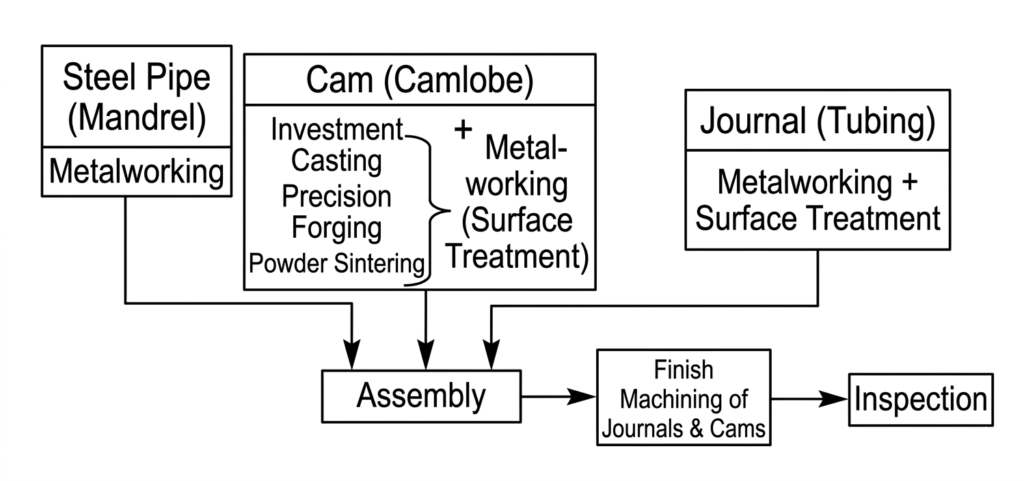
The source material gives typical assembly capability targets: cam angle accuracy of about ±0.5° for rough forged cams and ±0.25° for machined cams, axial dimension accuracy around ±0.1 mm, torque above 150 Nm, and axial load above 10 kN. Those numbers show why precision camshafts need controlled positioning and a joining method matched to the load case.
External research also treats joining strength as a central issue. For example, a Scientific Reports study on tube hydroforming connection strength frames the cam-to-tube interface as a key design variable for assembled camshafts (Scientific Reports, 2023).
Key Joining Methods for Built-Up Camshafts
Joining is the technical core of built-up camshaft design. The method must hold the cam lobe at the correct phase angle, transmit torque, resist axial load, and remain stable under heat, vibration, and repeated valve-train impact.
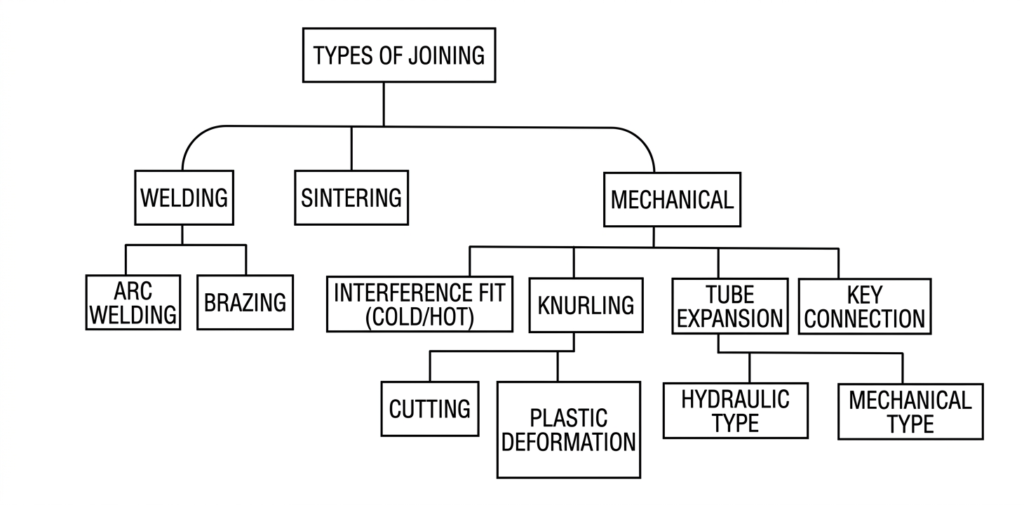
The main families are welded, sintered, and mechanical joining. A review indexed by Scientific.Net describes assembled camshaft joining technologies as a distinct research area because each method affects strength, accuracy, materials, and process cost (Scientific.Net).
| Joining method | Typical fit | Main advantage | Main limitation |
|---|---|---|---|
| Welding | Steel or alloy-steel components | Strong metallurgical connection | Heat distortion and crack control |
| Sintered joining | Powder-metal cams | Combines cam forming and diffusion joining | Furnace deformation and material limits |
| Tube expansion | Hollow shaft and cams with enough wall support | Good mechanical lock without welding heat | Requires high-pressure equipment and careful wall design |
| Hot/cold interference fit | Components with controlled bore and shaft sizes | Established mechanical assembly method | Interference can change with temperature |
| Knurling | Mechanical lock between cam and tube | Good balance of precision, equipment, and energy use | Requires controlled surface forming and validation |
A finite-element study of the Presta joining process in MDPI Metals also shows why simulation is useful: it helps predict contact pressure, deformation, and connection reliability before committing to tooling (MDPI Metals, 2018).
Why Assembled Camshafts Improve Camshaft Production
The strongest business case for assembled camshafts is not one isolated saving; it is the combination of material optimization, near-net-shape forming, lower cutting load, and more flexible assembly.
Source data reports several measurable advantages: hollow shaft construction and optimized cam materials can reduce total camshaft mass by 20%–40%, while material savings can exceed 30%. Near-net-shape cam lobes reduce the amount of metal removed by milling and grinding, and smaller components can be processed on more focused equipment before assembly.
Assembled camshafts also improve design flexibility. Engineers can adjust cam phase angle, axial position, lobe material, shaft stiffness, and end-part configuration without redesigning an entire integral forging. This is valuable for compact multi-valve overhead-cam layouts where cam spacing is tight.
Equipment and Automation Trends
Assembled camshaft production depends on repeatable positioning. Early assembly could rely on alignment fixtures, but higher-volume production favors robotic loading, dedicated or compound molds, precision locating tools, and CNC assembly machines.
The trend is toward closed, automated process control: load the cams and journals, locate them by phase angle and axial distance, apply the selected joining method, then verify angular accuracy, axial spacing, runout, torque capacity, and surface condition. This makes assembled camshaft manufacturing easier to integrate into repeatable production cells than a route built mostly around heavy stock removal.
For equipment buyers, the critical evaluation points are positioning accuracy, joining force or pressure control, thermal stability, inspection strategy, and how easily the line can switch between camshaft configurations.
Future Trends in Assembled Camshaft Manufacturing
The future of assembled camshaft manufacturing points toward more precise components and more controlled joining. Precision plastic forming, powder metallurgy, sintered cam materials, high-precision steel tubes, and automated inspection all reduce variation before final assembly.
Research and patents continue to describe built-up camshaft construction as a way to combine hollow shafts with separately produced lobes and journals (Justia Patents). The long-term direction is clear: lighter camshafts, fewer machining steps, stronger connection validation, and more flexible production systems for changing engine platforms.
FAQ
What is the difference between an assembled camshaft and a traditional camshaft?
A traditional camshaft is usually made from one cast, forged, or bar-stock blank, while an assembled camshaft is built from separate lobes, journals, and a shaft tube. The assembled route gives more freedom to choose different materials and processes for each functional area.
Which joining method is best for assembled camshafts?
There is no universal best method. Welding, sintering, tube expansion, interference fitting, and knurling each fit different torque, temperature, material, accuracy, and equipment constraints. The best method is the one that meets connection strength and positioning requirements with the least distortion and production cost.
Why do assembled camshafts reduce machining cost?
They reduce cost by shifting work from heavy stock removal to component-level forming and assembly. Near-net-shape cam lobes need less cutting, hollow shafts reduce material mass, and smaller parts can be heat-treated or finished more selectively before final assembly.
Are assembled camshafts suitable for high-performance engines?
Yes, when the joining process is validated for torque, axial load, thermal behavior, and fatigue life. Their main advantage in high-performance engines is the ability to combine compact layouts, optimized cam materials, reduced mass, and controlled assembly accuracy.
Conclusion
Assembled camshaft manufacturing is a practical advanced manufacturing route for precision camshafts that need lighter weight, flexible camshaft configurations, and less waste than one-piece production can offer. Its success depends on component quality, joining method selection, and automated control of phase angle and axial spacing.
For manufacturers planning camshaft production upgrades, the best next step is to compare the required cam materials, torque load, accuracy target, and production volume against the available joining and inspection strategy. UBright Solutions can support equipment discussions for precision shaft and engine-component manufacturing applications.
References
- Finite Element Simulation of the Presta Joining Process for Assembled Camshafts — MDPI Metals, 2018
- Finite-element analysis of connection strength of assembled camshafts using tube hydroforming — Scientific Reports, 2023
- State-of-the-Art of Joining Technologies for Assembled Camshaft — Scientific.Net, n.d.
- Built-Up Camshaft — Justia Patents, 2010