
*PLC control system for production lines* turns a sequence of manual assembly steps into a coordinated, repeatable, fully monitored process. On an automotive steering shaft line, where the part is a safety-critical component, that control layer is what guarantees every press-fit reaches the right depth and every bolt is tightened to the right torque, part after part. This article explains how a Siemens S7-300-based PLC control system runs a single-station steering shaft assembly line, how its fieldbus and software are structured, and what results a deployed line delivered.
Table of Contents
- What a PLC control system for a production line does
- System architecture: control, field, communication, operation
- Core stations on the steering shaft line (M03–M06)
- PLC software, HMI and data traceability
- Measured results on a deployed line
- FAQ
- Conclusion
What PLC control system for production lines does
In automotive production line automation, the PLC (programmable logic controller) is the decision-making core. It reads sensor signals from every station, runs the interlock and sequence logic, commands actuators such as cylinders and tightening tools, and reports the result of each operation upstream. For a steering shaft line, the PLC coordinates three core operation types — manual press-fit, pneumatic cylinder press-fit, and bolt tightening — so that a part only advances when the previous step has passed its quality check.
The design goal is a line that is automated, parameter-configurable, fault-predictive, and fully traceable. A modular program structure, built station by station, makes the same control platform easy to commission, maintain, and extend.
System architecture: control, field, communication, operation
The system is organized into four layers, each with a clear responsibility. This separation is what lets a single S7-class controller manage a multi-station line without the logic becoming tangled.
flowchart LR
    subgraph Operation["Operation layer"]
        HMI["WinCC Flexible HMI<br/>parameters, monitoring, alarms, traceability"]
    end
    subgraph Control["Control layer"]
        CPU["Siemens S7-300 CPU315-2PN/DP<br/>logic, station coordination, data"]
    end
    subgraph Comms["Communication layer"]
        PB["PROFIBUS DP fieldbus<br/>1.5 Mbps polling"]
        ETH["Industrial Ethernet TCP/IP<br/>HMI and host data"]
    end
    subgraph Field["Field layer"]
        IO["ET200S distributed I/O"]
        FESTO["FESTO CPX + MPA valve terminal"]
        BOSCH["BOSCH tightening controller"]
    end
    HMI --- CPU
    CPU --- ETH
    CPU --- PB
    PB --- IO
    PB --- FESTO
PB --- BOSCH- Control layer: a Siemens S7-300 CPU315-2PN/DP acts as the master controller, handling global logic, station coordination, and data processing.
- Field layer: ET200S distributed I/O modules collect signals and drive actuators, working with FESTO pneumatic elements and a BOSCH tightening system to perform the physical operations.
- Communication layer: a PROFIBUS DP fieldbus links the master to field devices, while industrial Ethernet (TCP/IP) carries data between the PLC, the host computer, and the HMI.
- Operation layer:* a WinCC Flexible HMI provides parameter setup, production monitoring, alarm handling, and data queries.
PROFIBUS DP fieldbus and industrial Ethernet
PROFIBUS DP fieldbus communication is the backbone for real-time control. The PLC master polls its slaves — ET200S I/O, the valve terminal, and the tightening controller — at 1.5 Mbps, fast enough that interlock and motion signals stay deterministic. Industrial Ethernet runs in parallel on a separate task: archiving production data, downloading recipes, and enabling remote monitoring, with IP addresses planned in segments so control traffic and information traffic do not compete.
Core stations on the steering shaft line (M03–M06)
The line runs four core stations, M03 through M06, each controlled as a modular step in the overall sequence.
| Station | Operation | Control focus |
|---|---|---|
| M03, M04.1 | Manual press-fit | Pre-assembly of sensor input shaft and bearings |
| M04.2 | Cylinder press-fit | Upper/lower housing engagement; press depth and pressure |
| M05 | Bolt tightening | Three bolts tightened in sequence, torque-angle control |
| M06 | Cylinder press-fit | Snap-ring press-fit; finished-part output |
flowchart LR
    A["M03 / M04.1<br/>Manual pre-assembly"] --> B["M04.2<br/>Cylinder press-fit<br/>housing engagement"]
    B --> C["M05<br/>Bolt tightening<br/>3 bolts in sequence"]
    C --> D["M06<br/>Cylinder press-fit<br/>snap-ring"]
    D --> E["Finished part output"]
Cylinder press-fit stations
At the M04.2 cylinder press-fit station, ET200S I/O (power module plus 8DI/8DO modules, hot-swappable) drives a FESTO CPX terminal with an MPA valve terminal. Cylinders with magnetic-ring position feedback and one-way flow restrictors eliminate the classic “stick-slip” crawl, so press motion is smooth and repeatable. Inductive proximity sensors confirm cylinder position and a through-beam photoelectric sensor verifies the black plastic part is present. The PLC sequence is strict: sensors confirm all parts in place, the clamp cylinder locks, the press cylinder descends until pressure is reached, the press retracts, and the clamp releases. If press position is out of tolerance or a sensor signal is lost, the part is rejected and an alarm is raised.
Automated bolt tightening (torque-angle) station
The M05 station is built around a BOSCH CS351E-D tightening controller and tightening spindle, the heart of the *automated bolt tightening torque control system*. It uses the torque-angle method and holds ±3% tightening accuracy. Inductive proximity sensors locate each bolt position, and a Balluff ring sensor detects rejected bolts.
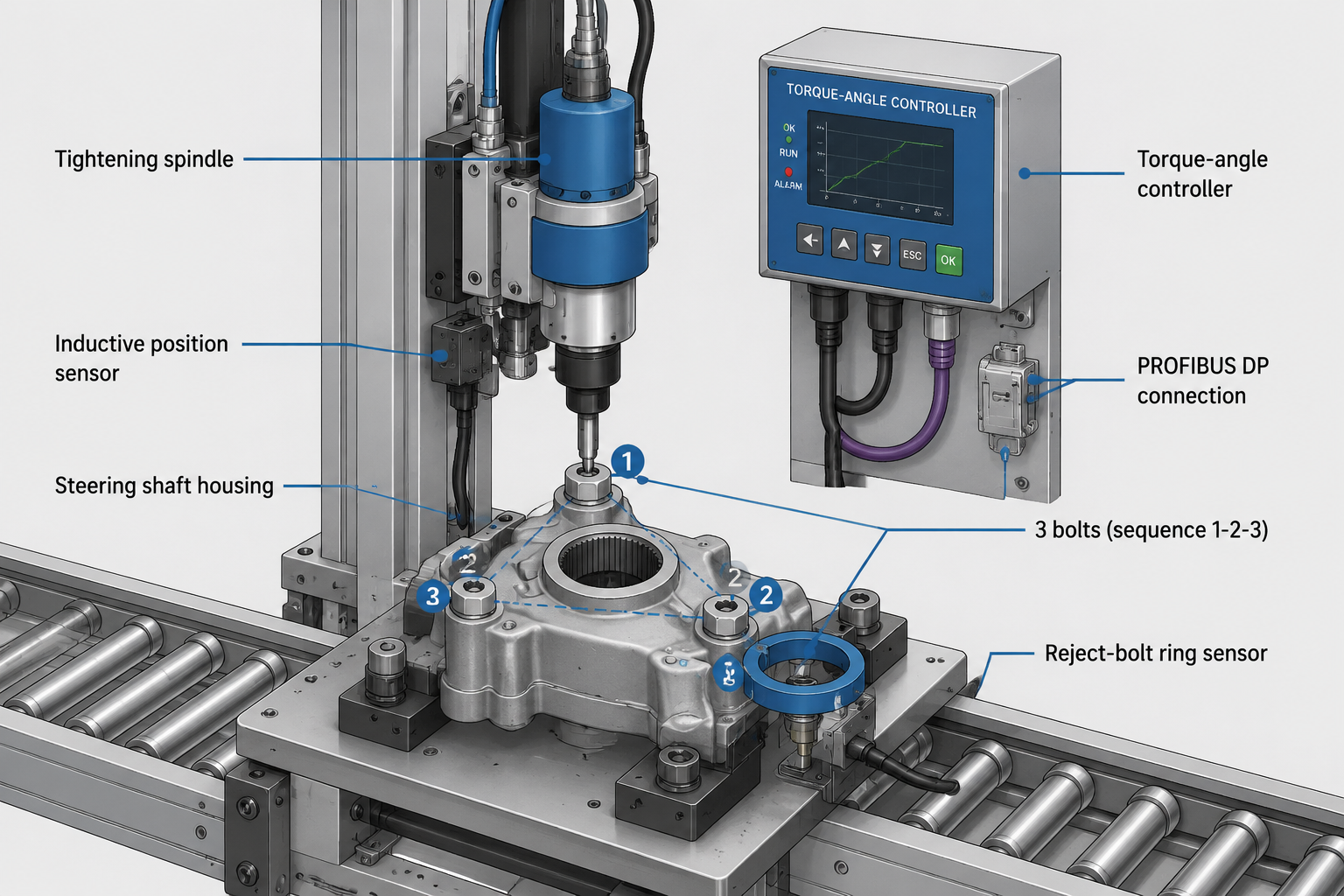
flowchart LR
    P["Spindle moves to bolt<br/>inductive sensor confirms position"] --> T["Tighten bolts 1 to 3 in sequence<br/>monitor torque and angle"]
    T --> Q{"Within ±3%?"}
    Q -->|Yes| OK["Pass, advance part"]
    Q -->|No| R["Run loosening program<br/>reject bolt to scrap, allow rework"]
The PLC monitors torque and angle in real time as bolts 1, 2, and 3 are driven in order. If a reading is out of range, it calls the loosening program; the scrap bolt is verified by the ring sensor and dropped into the scrap bin, and the part can be reworked. An MFU capability module supports 25 consecutive tightening tests to validate process stability.
PLC software, HMI and data traceability
The control program is written in SIMATIC STEP7 V5.5 using a modular approach, with program blocks (FB/FC) split by station so the line is easy to debug and maintain. The languages are mixed to fit each job: GRAPH sequential steps drive the production flow, ladder logic (LAD) handles interlocks, and statement list (STL) optimizes data handling. Core function modules include a cycle-time module (FB1), a counting module (FC504) for total, pass, and fail counts, a calibration module (FB62) that periodically recalibrates press force and tightening torque, and an alarm module (FC25) that surfaces faults such as e-stop triggers and sensor faults as HMI pop-ups.
On the WinCC Flexible HMI, operators move between a main screen (counts, cycle time, status), a parameter screen (cylinder pressure, tightening torque, calibration interval), an alarm screen with fault history, and a traceability screen that retrieves the machining parameters and pass status of any single part. Access levels separate administrators from operators so critical parameters are protected.
Traceability is built into the data design. The PLC sends control commands downstream over PROFIBUS DP and collects sensor and tightening data upstream over industrial Ethernet to the host. Key records are stored in DB blocks packaged as “part number + time + process parameters + pass status,” which is exactly what an automotive safety part needs for fault tracing and quality audits.
Measured results on a deployed line
This solution has been deployed and passed full-function testing at an automotive component manufacturer. In UBright’s project experience on that line, automating the core stations and adding real-time quality checks delivered three measurable gains: throughput rose by about 30% with single-part cycle time cut to under 120 seconds, product pass rate reached 99.5% as high-precision control reduced human error, and maintenance cost fell by roughly 20% because the modular design simplifies fault isolation and remote monitoring reduces on-site attendance.
FAQ
Why use PROFIBUS DP instead of plain Ethernet on an assembly line?
PROFIBUS DP fieldbus communication uses deterministic master-slave polling, so control and interlock signals arrive within a predictable time. Industrial Ethernet still has a role here, but for data archiving, recipe download, and remote monitoring rather than time-critical motion control. Running both keeps information traffic from delaying control traffic.
What is torque-angle bolt tightening and why ±3%?
Torque-angle control monitors both the applied torque and the rotation angle of each bolt, which catches problems like cross-threading or soft joints that a torque-only method can miss. Holding ±3% accuracy on a steering shaft matters because the joint is safety-critical; the PLC rejects any bolt outside the window and allows controlled rework.
Can a single-station PLC control system scale to more stations?
Yes. The ET200S distributed I/O architecture and PROFIBUS DP bus are designed for expansion, so adding a station is largely a matter of adding I/O and a program block rather than rebuilding the control core.
How does the line ensure traceability for safety parts?
Every part’s number, timestamp, process parameters, and pass status are stored together in PLC DB blocks and archived over Ethernet, so any finished steering shaft can be traced back to its exact press forces and tightening results.
Conclusion
A well-structured PLC control system for a production line is what makes automotive steering shaft assembly both fast and trustworthy: a Siemens S7-300 core, PROFIBUS DP fieldbus, distributed I/O, and torque-angle tightening working together under one modular program, with full data traceability behind every part. If you are planning or upgrading a steering shaft or similar safety-part assembly line, UBright can help scope the control architecture, station hardware, and automation strategy to your part and cycle-time targets — contact us with your drawings or machining requirements for a tailored proposal.
References
- PROFIBUS technology overview — Supports the PROFIBUS DP fieldbus communication and master-slave polling description.