
When a press brake bends a long sheet, the ram and the bed do not stay perfectly straight. Under load they flex, the gap between punch and die opens slightly in the middle, and the finished part ends up with a looser bend angle at its center than at its ends. CNC hydraulic press brake deflection compensation — usually called crowning — cancels that flex so a 3-meter bend holds the same angle end to end. This article explains what deflection compensation is, why it decides bending accuracy, and how a frame is designed and validated with finite element analysis (FEA) to keep deflection inside tight limits.
Table of Contents
- What is press brake deflection compensation?
- Why deflection compensation matters for bending accuracy
- How a CNC hydraulic press brake compensates deflection
- Designing the machine with finite element analysis
- Design results: weight, stress, and accuracy gains
- Applications and selection considerations
- FAQ
- Conclusion
What is press brake deflection compensation?
Press brake deflection compensation is a mechanism that bends the worktable (bed) upward by a controlled amount so it matches the downward flex of the ram during a bend. When the two deflection curves match, the punch-to-die gap stays uniform across the full bending length, and the bend angle stays consistent from one end of the part to the other.
The flex itself is unavoidable. A press brake applies its full tonnage through a ram driven at both ends, while the workpiece reacts along the entire length between the side frames. That loading makes the ram bow downward in the middle and the bed deflect away from it — the classic C-frame “throat opening” effect. Compensation does not eliminate the flex; it deliberately introduces an equal and opposite curve in the bed so the net gap error goes to zero. This is why the technique is commonly called crowning: the bed is given a slight crown that disappears under load.
Why deflection compensation matters for bending accuracy
Bend angle is set by how far the punch penetrates the die. If the gap opens by even a few hundredths of a millimeter in the middle of a long bend, the center of the part is under-bent relative to the ends. On a short part this is negligible; on a long part it produces a visible, measurable angle variation that fails inspection and stacks up badly in assemblies.
The amount of flex scales with bending length and tonnage, so the longer and heavier the job, the more compensation matters. A machine targeting B-grade bending accuracy works to a straightness tolerance on the order of length divided by 5000 — for a 3200 mm bed, that is well under a millimeter of allowable deviation across the whole length. Hitting that target reliably depends on two things working together: a frame stiff enough to keep total deflection small, and a compensation system precise enough to cancel the deflection that remains. As industry guides on press brake crowning and overcoming deflection explain, crowning is what lets a press brake deliver a uniform angle along bends that would otherwise come out barreled.
How a CNC hydraulic press brake compensates deflection
Compensation has two parts: a frame designed to limit how much the structure flexes, and an active crowning system that shapes the bed to match the ram.
Crowning compensation cylinders
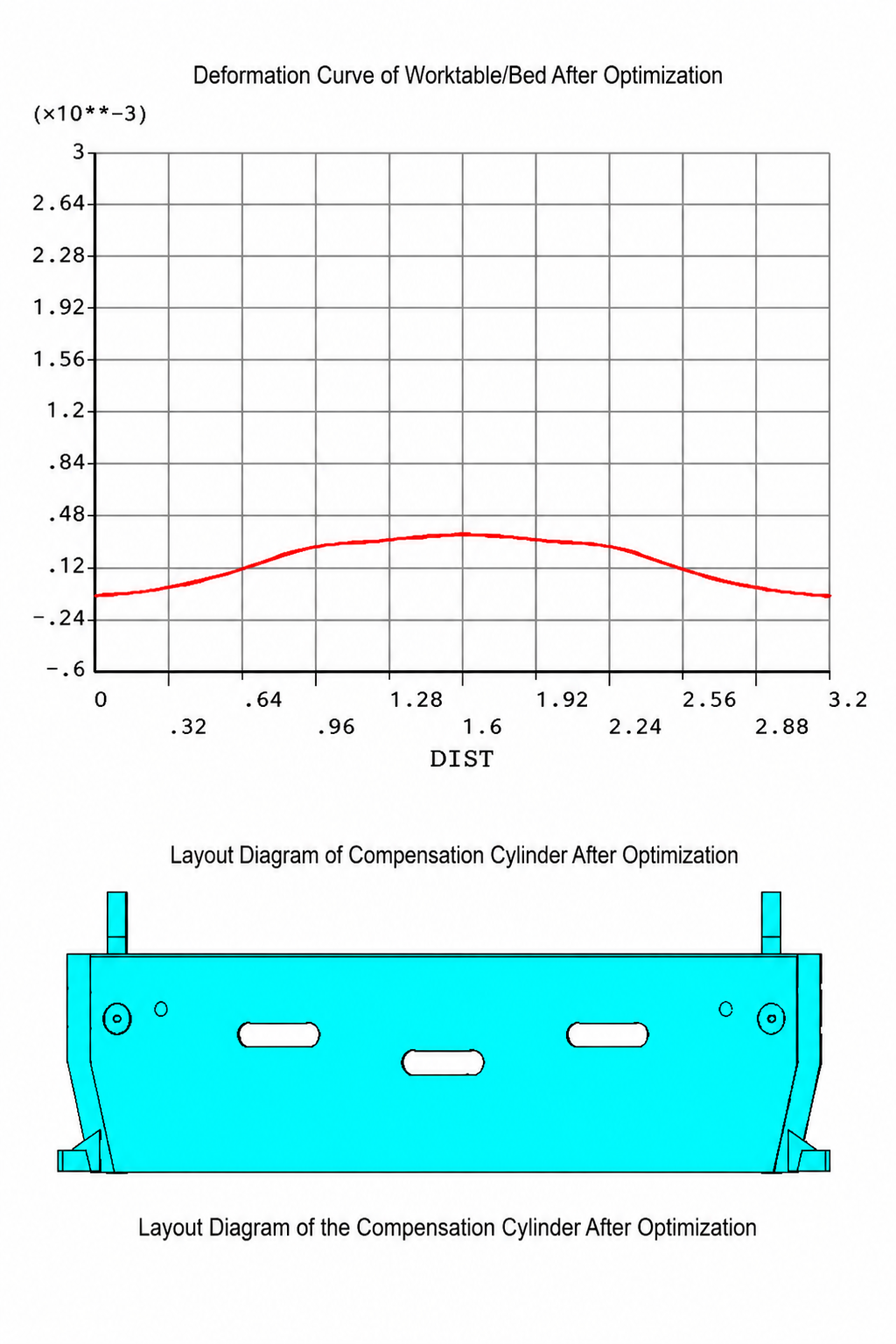
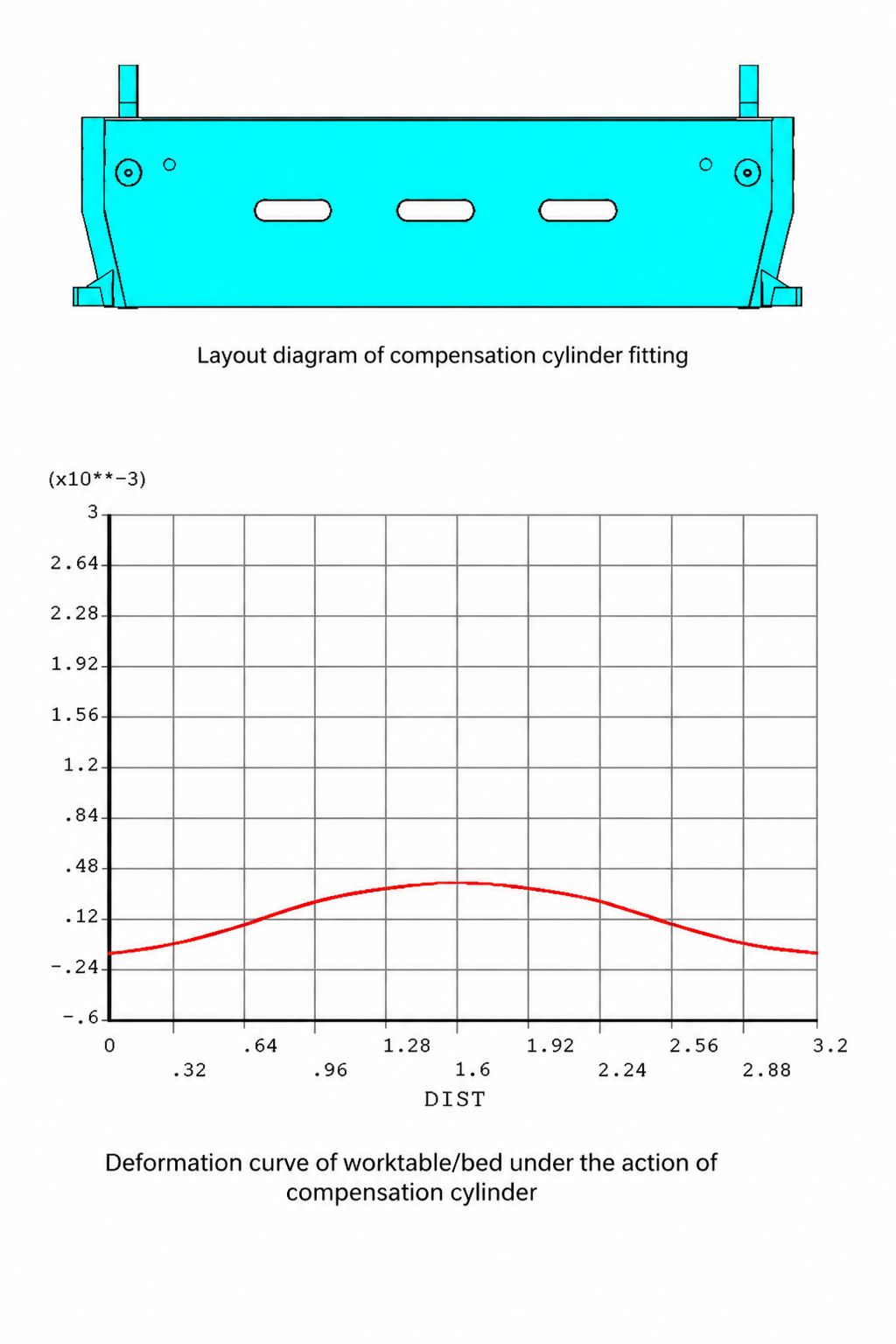
In a hydraulically crowned bed, a series of cylinders sits beneath the worktable. By adjusting their positions and the pressure they apply, the bed is pushed up in a curve that mirrors the ram’s downward bow. In the reference design discussed here, the layout was optimized so the two side cylinders sit 700 mm from the center cylinder horizontally and are offset 100 mm vertically relative to it. That arrangement produces a maximum compensation of 0.44 mm, which fits against the 0.46 mm maximum deflection at the center of the ram. The small residual is what keeps the punch-die gap uniform along the length.
Because the worktable deflects upward to cancel the ram’s downward deflection, the result is a flat effective bending line under load. Simulation of the optimized layout put the resulting bending dimensional accuracy at ±0.10 mm.
Frame design: throat, side plates, reinforcing ribs
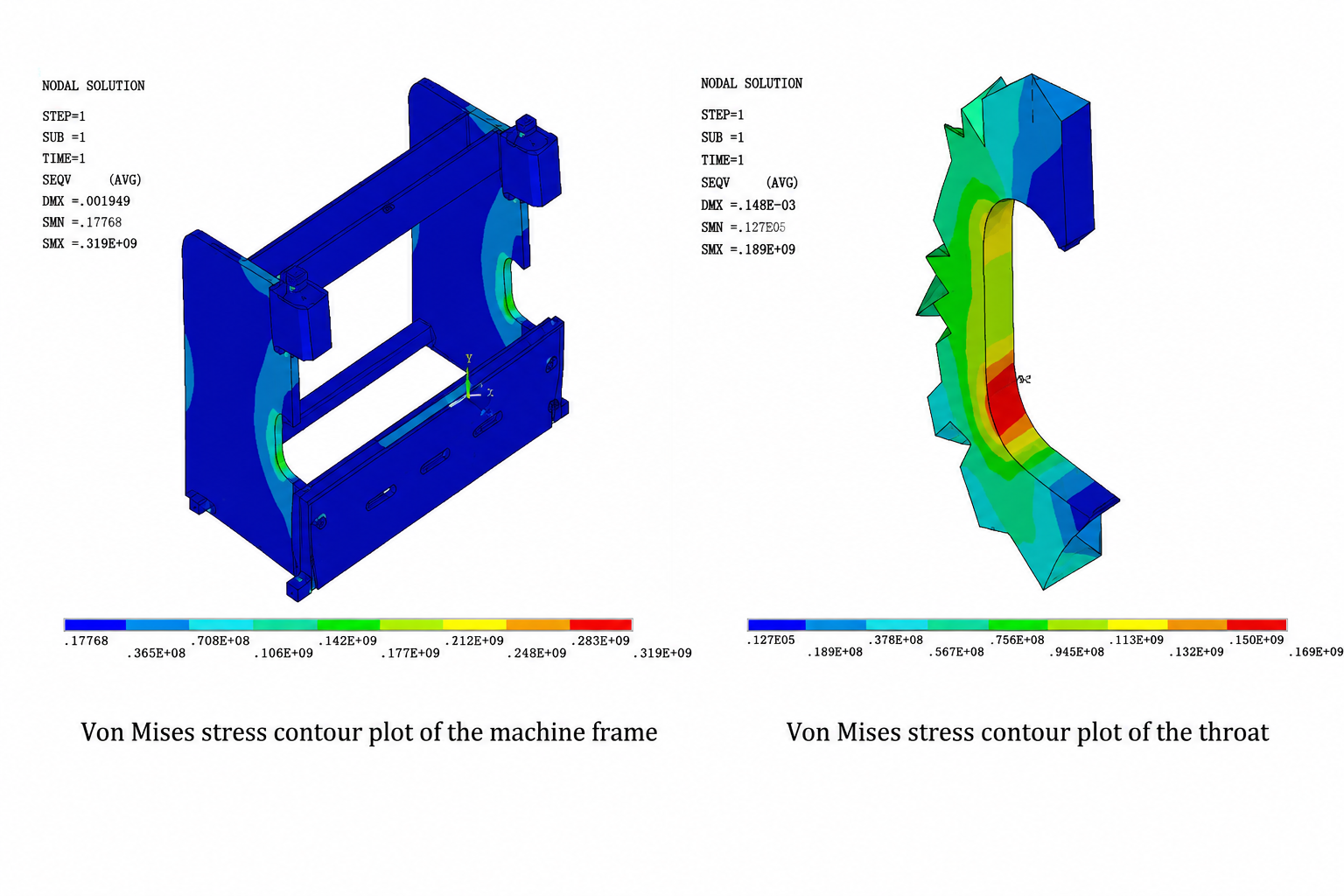
The less the structure flexes to begin with, the less work the crowning system has to do. Stiffness is concentrated where stress concentrates — the throat of the C-frame and the side plates. In the reference design, the side plate width was set to 1350 mm and the throat fillet radius to 160 mm, and C-shaped reinforcing ribs were added on the inner and outer sides of the throat to strengthen that high-stress region. Those choices pulled peak throat stress down sharply while keeping the machine light enough to be economical to build.
Designing the machine with finite element analysis
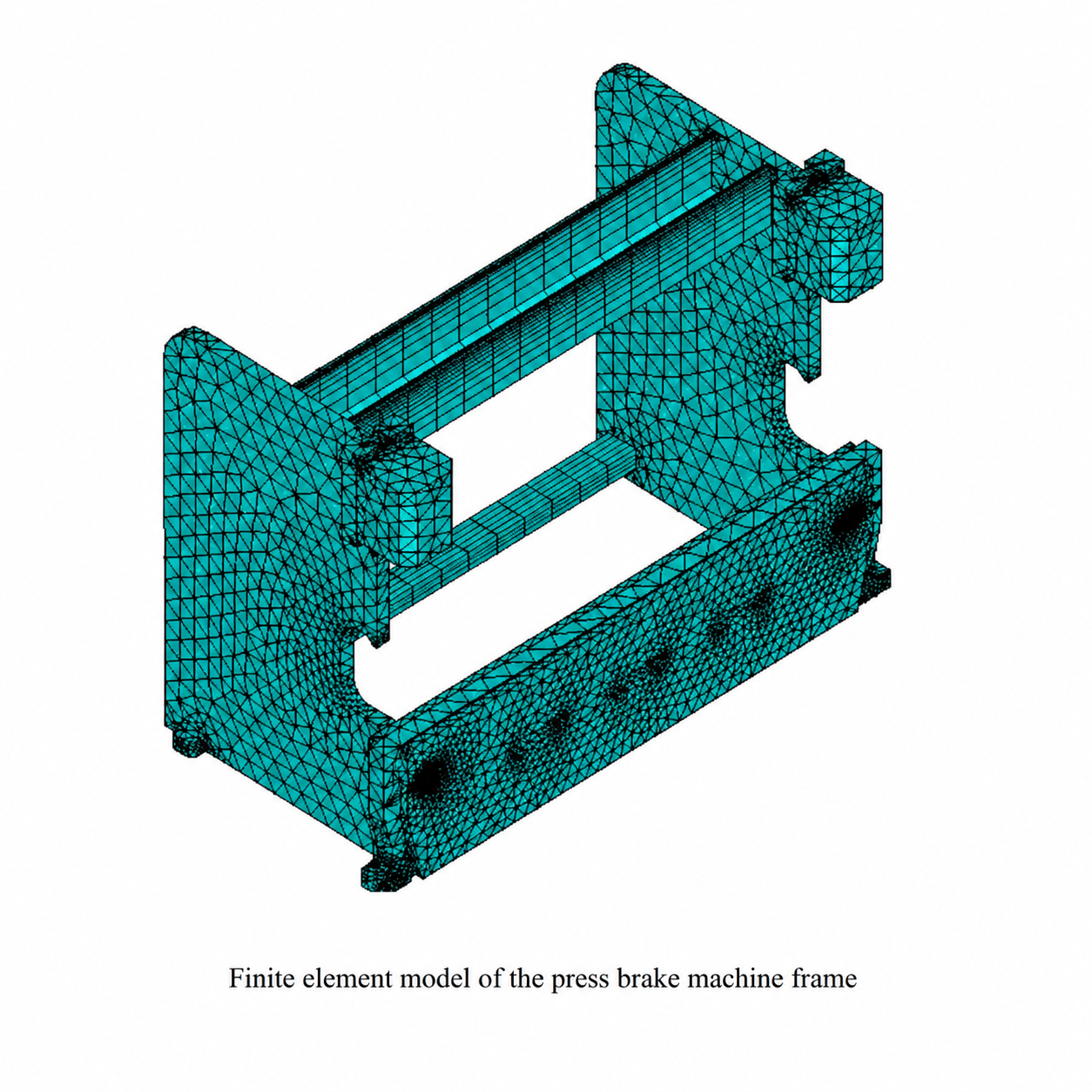
A modern press brake frame is designed in 3D CAD (SolidWorks) and validated in FEA (ANSYS) before any steel is cut. Non-critical features like screw holes and process chamfers are simplified, while stress-concentration regions such as the throat and cylinder connection faces keep their detail so the model behaves like the real structure.
The main structure is welded from Q235 steel, modeled with an elastic modulus of 2.0×10¹¹ Pa, a Poisson’s ratio of 0.27, and a density of 7.8×10³ kg/m³. (Q235 is a common low-carbon structural steel; published structural steel property tables list comparable stiffness and density values for grades in this class.) The frame, ram, and worktable are meshed with solid elements — tens of thousands of them, with the frame alone divided into 71,716 elements, the ram into 5,469, and the worktable into 13,273 — to balance accuracy against solver time.
Static structural and contact analysis
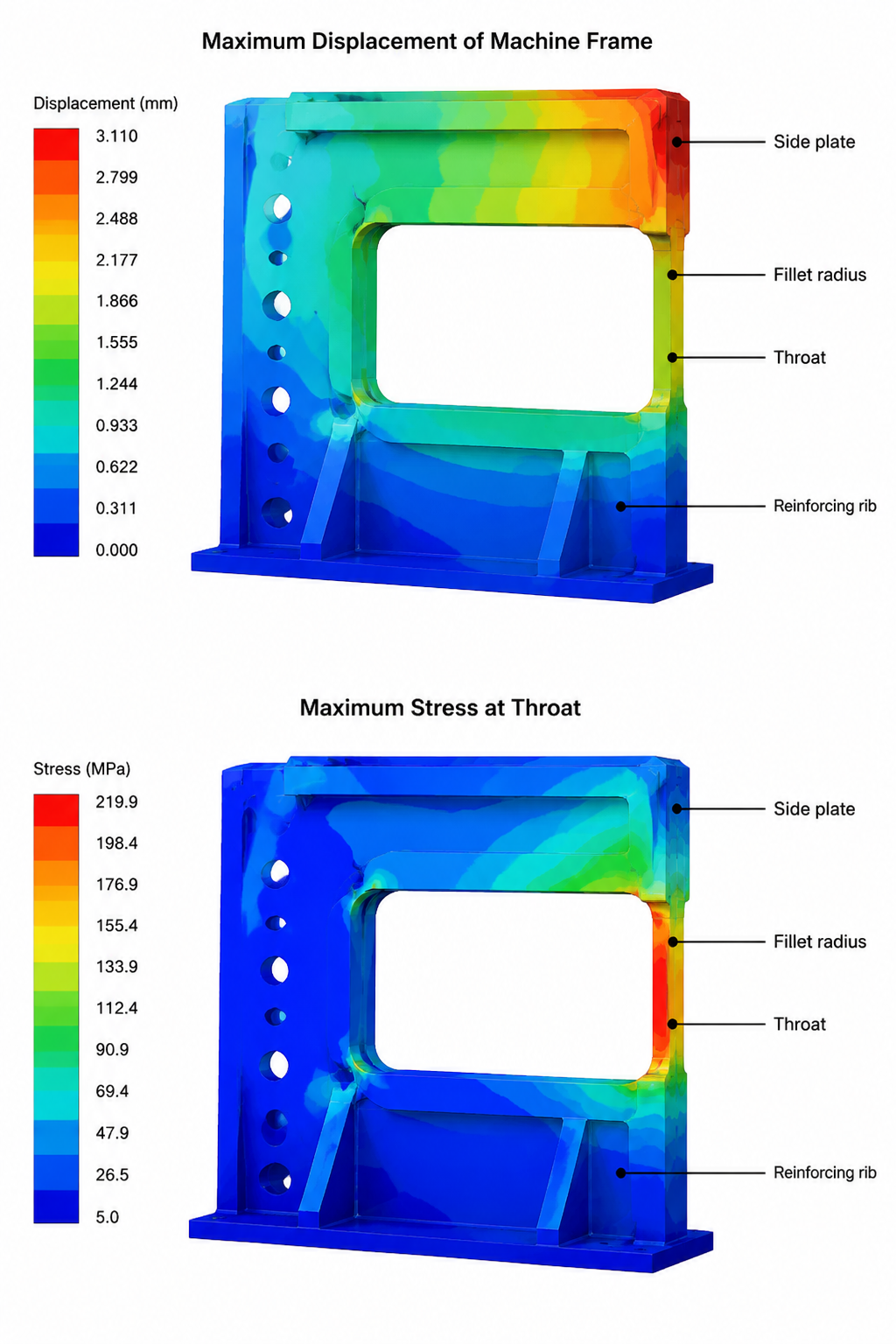
Three representative load cases are analyzed: a uniform load across the full bed length, a uniform load across the middle 60% of the length, and an offset load across 60% on one side. The frame base is fixed, and the hydraulic cylinder piston applies a 27.09 MPa distributed load. Static analysis maps where the structure flexes and where stress peaks — almost always at the throat.
A nonlinear contact analysis then models the ram and worktable as a face-to-face contact pair using an augmented Lagrange algorithm, which balances contact stiffness against solver convergence. This step corrects the load-distribution approximations of the static model — the real working load follows a cosine distribution — and confirms the structure stays within the allowable stress of Q235: the ram peaks at no more than 151 MPa and the worktable at no more than 161 MPa across all three load cases.
Modal analysis and resonance avoidance
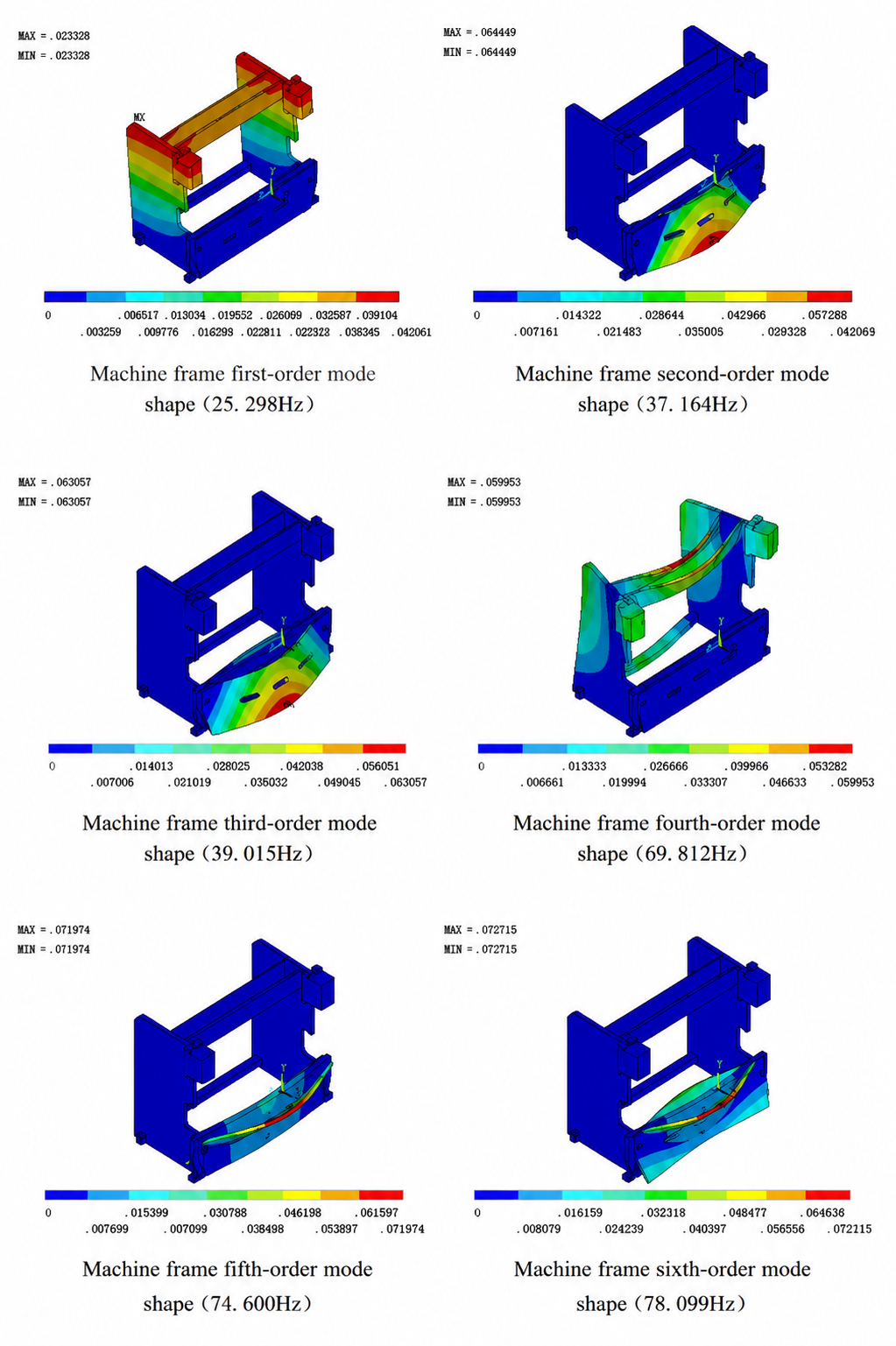
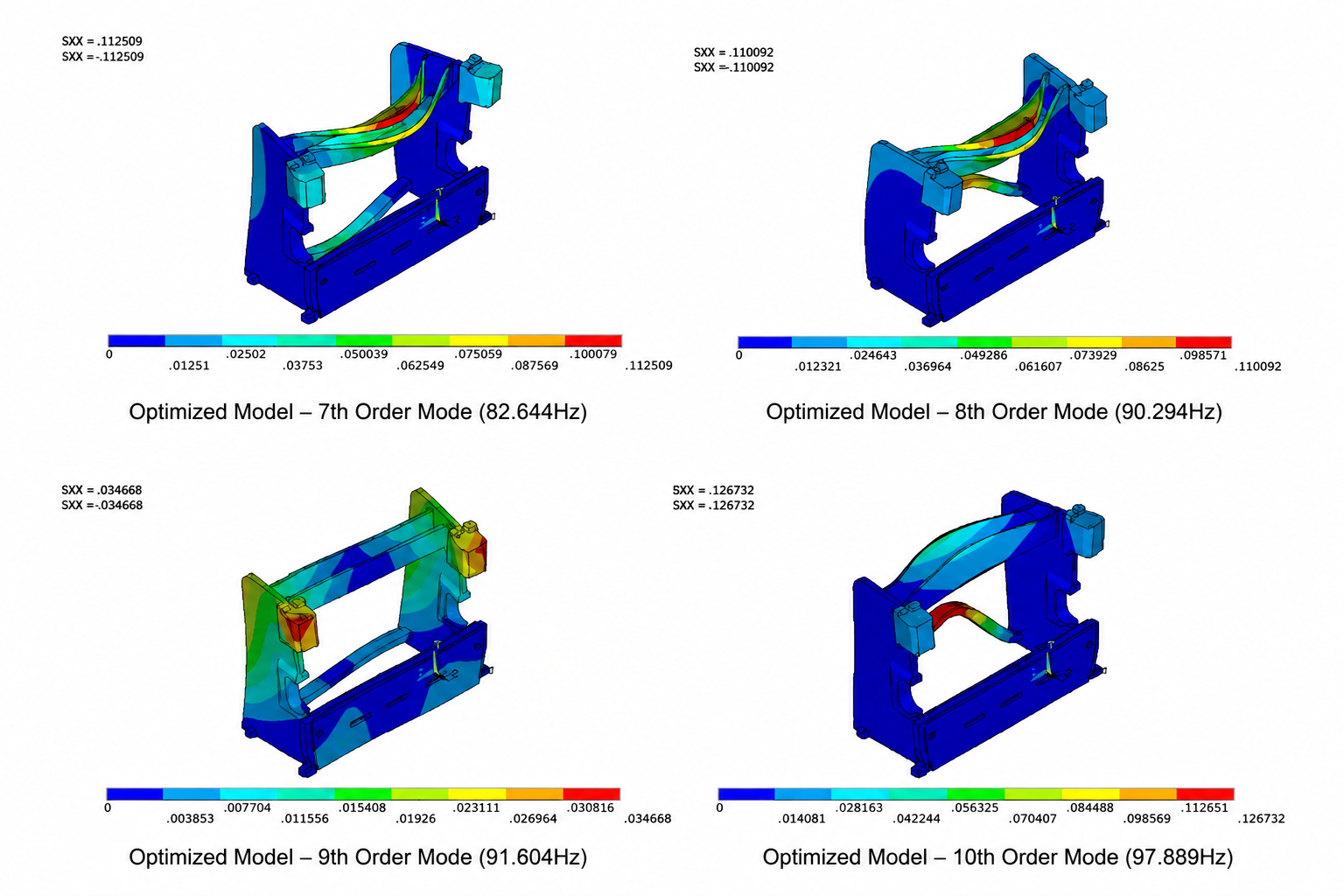
Modal analysis extracts the frame’s natural frequencies and mode shapes so the design can be kept clear of resonance. A machine that runs near one of its own natural frequencies vibrates heavily, which wears parts and spoils accuracy. The rated bending rate here is about 20 strokes per minute, so the first natural frequency must sit well above that excitation. Optimizing the rib layout and adding a local baffle in the oil tank lifted the first natural frequency from 25.298 Hz to 28.686 Hz — comfortably clear of the working frequency — while damping the harmful mode shapes that affect accuracy, such as the swaying of the upper frame and vibration of the worktable panel.
Design results: weight, stress, and accuracy gains
The payoff of an FEA-driven, optimization-based design is that strength, stiffness, dynamic behavior, and weight all improve together instead of trading off against each other. Using a zero-order optimization method with frame volume as the objective and deflection and stress limits as constraints, the reference design achieved the following:
– *Weight: frame mass dropped from 8410 kg to 7712 kg — about a 9% reduction — cutting material and manufacturing cost. – Throat stress: peak throat stress fell from 169 MPa to 111 MPa, well inside the allowable range for Q235. – Deflection: maximum vertical displacement was reduced from 1.468 mm to 1.388 mm, and overall frame deformation was held to no more than 1.996 mm. – Dynamic stiffness: first natural frequency rose from 25.298 Hz to 28.686 Hz, removing the resonance risk at the 20 strokes-per-minute working rate. – Accuracy:* with the optimized compensation cylinder layout, bending dimensional accuracy reached ±0.10 mm.
Optimized dimensions were also rounded to standard machining values, so the design stays practical to manufacture and maintain in volume production.
Applications and selection considerations
This class of CNC hydraulic press brake suits medium-to-large sheet metal fabrication across automotive, aerospace, electronics, and construction-materials industries. The reference machine covers a nominal force of 2500 kN and a bending length of 3200 mm, handling bending, channel forming, and shallow drawing on metal plate — particularly for multi-batch, high-accuracy work.
When specifying a press brake for accuracy-critical work, weigh three things together. First, match nominal force and bending length to your heaviest and longest realistic job, not the average one. Second, confirm the frame is stiff enough that compensation has little residual flex to correct — a stiff frame plus active crowning beats a flexible frame leaning on crowning alone. Third, check that the crowning system resolution suits your tolerance band; a system shaped to fit the actual ram deflection curve, as above, is what delivers a consistent angle along the full length.
FAQ
What causes deflection in a press brake?
Deflection comes from the bending force itself. The ram is driven at both ends but the workpiece reacts along the whole length between them, so the ram bows downward in the middle while the C-frame throat opens. The effect grows with tonnage and bending length, which is why long, heavy bends show it most.
How does press brake crowning work?
Crowning bends the worktable upward by a controlled, length-varying amount that mirrors the ram’s downward flex. In hydraulic crowning, cylinders under the bed are positioned and pressurized so the bed curve fits the ram curve, keeping the punch-die gap uniform so the bend angle stays consistent end to end.
What bending accuracy can a CNC hydraulic press brake achieve?
It depends on frame stiffness and crowning precision, but a well-optimized design can reach around ±0.10 mm bending dimensional accuracy and hold straightness on the order of length divided by 5000. Reaching those numbers reliably requires both a stiff frame and a compensation system tuned to the actual deflection curve.
Is deflection compensation needed for short parts?
For short bends the flex is usually small enough to ignore, so compensation adds little. It becomes important as bending length and tonnage rise — long parts are where uncompensated deflection produces a visible, measurable angle variation between the center and the ends.
Conclusion
Deflection compensation is what turns a press brake’s raw tonnage into a consistent bend angle along the full length of a long part. The most reliable results come from designing the frame for stiffness first — concentrating material at the throat and side plates and verifying it with static, contact, and modal FEA — and then tuning a crowning system to cancel the deflection that remains. Done together, that approach delivered a 9% lighter frame, lower throat stress, a higher first natural frequency, and ±0.10 mm bending accuracy in the reference design. If you are planning equipment for accuracy-critical sheet metal work, or need machining and forming support for medium-to-large parts, contact UBright Solutions at info@ubrightsolutions.com to discuss your drawings, tolerances, and production requirements.
References
- Better bend accuracy on the press brake through crowning — Supports the explanation of how crowning produces a uniform bend angle along the bending length.
- The battle to overcome deflection — Supports the relationship between press brake deflection, bending length, and accuracy.
- Table of material properties for structural steel — Supports the general stiffness and density values used for Q235-class structural steel.