
Thread plug gauge grinding is the precision external-thread grinding process used to manufacture plug gauges for checking internal screw threads. A reliable thread plug gauge grinding solution must control thread form, pitch, lead, helix angle, and surface finish for gauge-making work. For ISO metric threads, ISO 1502 covers gauges and gauging, while ISO 68-1, ISO 724, and ISO 965-1 define thread profile, dimension, and tolerance context.
What Is Thread Plug Gauge Grinding?
Thread plug gauge grinding is the controlled grinding of external thread profiles on plug gauges used to inspect internal threads. The process shapes the gauge’s thread form, pitch, lead, and diameter so the finished tool can be used for pass/fail thread inspection.
A plug gauge is used for internal threads, so the gauge itself has an external thread. That makes external thread grinding central to plug gauge production. For Unified inch screw thread applications, ASME B1.2 provides the relevant gaging reference.
Why Thread Plug Gauge Grinding Requires CNC Control
Thread plug gauge grinding requires CNC control because small errors in lead, pitch, flank angle, or profile can affect how the gauge engages the inspected internal thread. ISO 68-1 defines metric thread profile context, and ISO 965-2 covers limits of sizes for ISO metric internal and external threads.
In precision gauge manufacturing, the machine must synchronize workpiece rotation, table movement, and wheelhead infeed. The wheel path must follow the programmed thread lead while holding the required profile. A suitable CNC grinding solution also needs controlled wheel dressing, because each dressing amount changes the wheel condition and should be compensated in the wheelhead feed.
External Thread Grinding Applications and Workpiece Range
This cylindrical thread grinding machine application is intended for large-size external thread plug gauges, especially for toolmakers, gauge manufacturers, and precision machining suppliers. It is suitable for cylindrical and conical plug gauges when the workpiece geometry falls within the machine’s capacity.
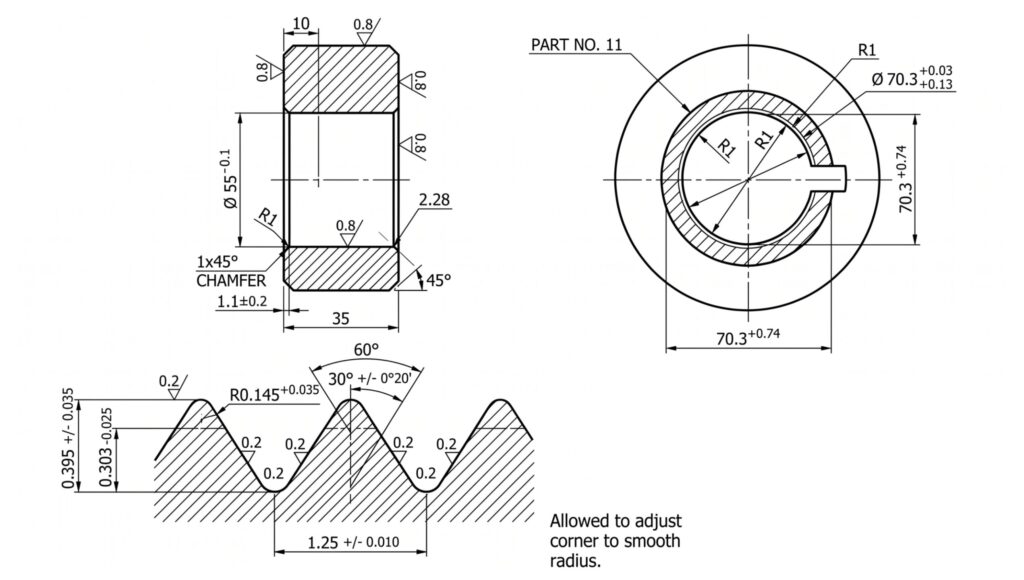
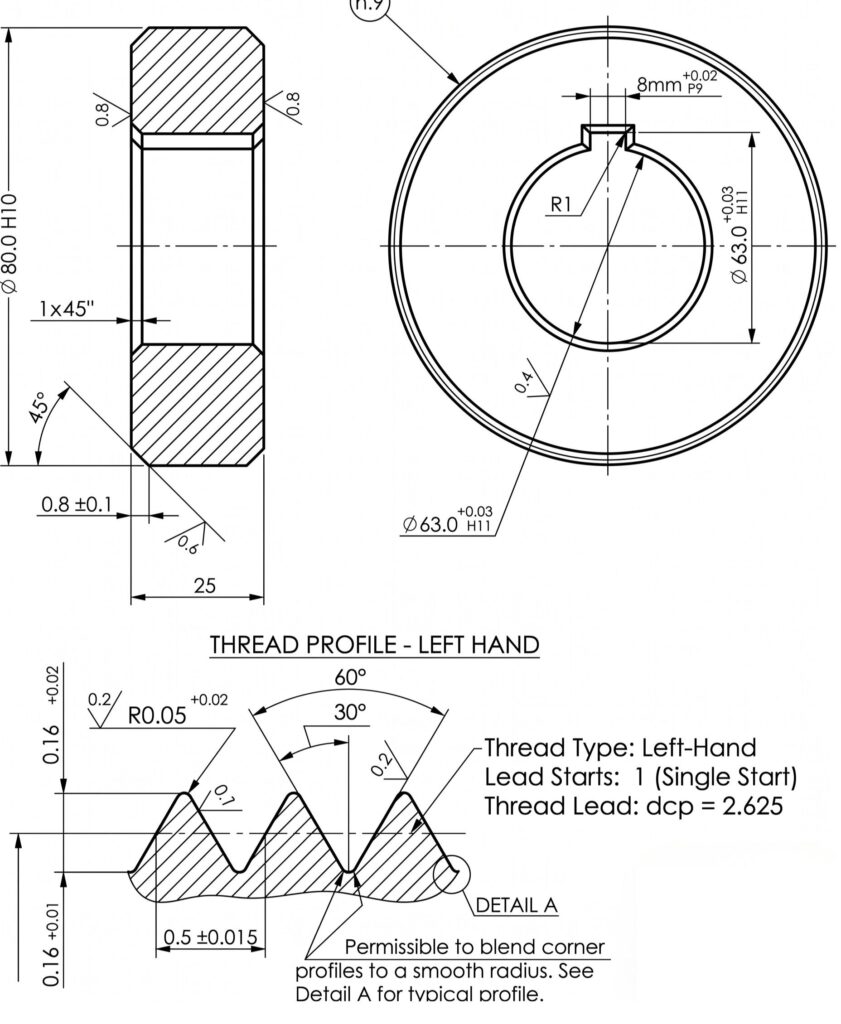
The source configuration supports triangular, saw-tooth, trapezoidal, and circular-arc external thread forms. That range helps manufacturers serve different gauge families instead of only one thread type. External thread grinding is especially useful when the plug gauge needs repeatable geometry and a finished thread surface after prior machining or heat-treatment steps.
CNC Thread Grinding Machine Configuration and Control
A CNC thread grinding machine for plug gauges should be evaluated as a coordinated system, not as a standalone spindle. The CNC, axis configuration, dressing system, feedback control, and workholding all affect the final thread.
Six-axis, three-axis-linked CNC control
The referenced machine uses six-axis CNC control with three-axis coordinated linkage. This allows the machine to coordinate the rotational and linear motions needed for thread generation and helps maintain lead accuracy over the full thread length.
Servo-controlled wheel dressing compensation
Wheel dressing is part of the grinding cycle. The machine uses a servo-controlled dressing feed, and each dressing amount can be compensated into the wheelhead feed. This reduces manual correction and supports more consistent grinding conditions across repeated parts.
Closed-loop feedback options
Closed-loop feedback can be configured for worktable movement and wheelhead feed through linear scales. The headstock spindle can also use an incremental rotary encoder. These feedback elements help the plug gauge grinding machine maintain position and synchronization during precision grinding.
Machine Specifications That Matter
For thread gauge production, the most important specifications are workpiece envelope, thread length, pitch or TPI range, helix angle, axis speeds, spindle speed, and wheel capacity.
| Specification | Value |
|---|---|
| Maximum workpiece diameter | 400 mm |
| Maximum center distance | 500 mm |
| Grindable diameter range | 50–400 mm |
| Maximum thread grinding length | 380 mm |
| Metric thread pitch range | 0.5–8 mm |
| Inch thread range | 3–40 TPI |
| Maximum thread helix angle | ±30° |
| Maximum worktable travel speed | 3000 mm/min |
| Maximum wheelhead travel speed | 1000 mm/min |
| Headstock spindle working speed | 0.5–45 r/min |
| Grinding wheel spindle speed | 2145–2860 r/min |
| Maximum grinding wheel linear speed | 45 m/s |
| Grinding wheel size | OD 300–400 mm, ID 203 mm, width 10 mm |
These values show a solution for large external thread plug gauges with CNC movement, automatic dressing compensation, and pitch coverage for metric and inch-thread work.
How the CNC Grinding Process Works
A typical thread plug gauge grinding process starts with confirming the gauge standard, thread size, pitch or TPI, thread form, workpiece diameter, thread length, and helix angle. The workpiece is then set between centers.
During grinding, the CNC system coordinates workpiece rotation with table movement and wheelhead infeed. The grinding wheel forms the thread profile while the machine follows the programmed lead. When the wheel is dressed, the dressing amount is compensated into the wheelhead feed so the next grinding pass reflects the corrected wheel condition.
Final inspection should verify the gauge against the applicable design and gauging requirements. ISO 1502 is the central reference for ISO metric screw thread gauges; ASME B1.2 applies to Unified inch screw thread gaging.
What Manufacturers Should Evaluate Before Thread Gauge Production
Before selecting a thread plug gauge grinding solution, manufacturers should confirm the thread family and inspection standard. ISO metric screw thread gauges and Unified inch screw thread gauges follow different references, so the drawing should specify which system applies.
The next checks are workpiece diameter, center distance, thread length, pitch or TPI, helix angle, and whether the plug gauge is cylindrical or conical. Manufacturers should also evaluate CNC interpolation, wheel dressing compensation, linear feedback, spindle feedback, changeover workflow, and production mix.
FAQ
What is thread plug gauge grinding?
Thread plug gauge grinding is the precision grinding process used to produce the external thread on a plug gauge for inspecting internal screw threads.
How are thread plug gauges ground?
Thread plug gauges are ground by synchronizing workpiece rotation with table movement and wheelhead infeed while the grinding wheel follows the programmed thread lead.
What machine is used for thread plug gauge manufacturing?
A CNC thread grinding machine for plug gauges is typically used when the work requires repeatable external thread geometry, controlled wheel dressing, and accurate axis synchronization.
How do ISO standards affect plug gauge grinding?
ISO standards define the thread profile, basic dimensions, tolerances, and gauging framework for ISO metric screw threads, which guide the geometry the grinding process must support.
How to choose a grinding machine for thread gauges?
Choose a grinding machine for thread gauges by checking the standard, workpiece size, thread length, pitch or TPI range, helix angle, CNC synchronization, dressing compensation, and feedback options.
What specifications matter for plug gauge grinding?
The key specifications are grindable diameter range, thread grinding length, pitch or TPI range, helix angle capacity, worktable speed, wheelhead feed, spindle speed, wheel size, and closed-loop feedback.
Conclusion
A thread plug gauge grinding solution should be selected around gauge geometry and inspection standard. For large external thread plug gauges, CNC axis coordination, servo dressing compensation, and closed-loop feedback help manufacturers produce consistent thread profiles across cylindrical or conical workpieces. UBright Solutions can help evaluate the required CNC grinding solution based on thread standard, workpiece envelope, pitch range, helix angle, and production mix.
References
- ISO 1502:1996 — ISO general-purpose metric screw threads — Gauges and gauging — Supports the discussion of gauges and gauging for ISO general-purpose metric screw threads.
- ISO 68-1:2023 — ISO general purpose screw threads — Basic and design profiles — Part 1: Metric screw threads — Supports the explanation of metric screw thread basic and design profiles.
- ISO 724:2023 — ISO general purpose metric screw threads — Basic dimensions — Supports the discussion of basic metric screw thread dimensions.
- ISO 965-1:2026 — ISO general purpose metric screw threads — Tolerances — Part 1: Principles and basic data — Supports the discussion of tolerance principles and basic data for metric screw threads.
- ISO 965-2:2024 — ISO general purpose metric screw threads — Tolerances — Part 2: Limits of sizes for internal and external threads — Supports the explanation of limits of sizes for ISO metric internal and external threads.
- ASME B1.2 — Gages and Gaging for Unified Inch Screw Threads — Supports the note that Unified inch screw threads use a separate gaging reference.